Quick summary
The Crowntail Betta is an easy-to-keep, hardy variant of Betta splendens with sturdier, less tear-prone fins than varieties like the Halfmoon, making it a forgiving choice for beginners who want a striking-looking betta without excessive fin fragility. It needs only a 41 litre heated, filtered tank kept alone or with carefully chosen calm tank mates, though breeding is rated moderate difficulty and males must never be housed together.
🐠 Build a tank around this species
In this guide:
- Introduction
- Quick Stats
- Appearance
- Varieties and Morphs
- Natural Habitat
- Tank Size and Setup
- Water Parameters
- Filtration and Equipment
- Diet and Feeding
- Behaviour and Temperament
- Tank Mates
- Breeding
- Common Diseases
- FAQs
Introduction
The Crowntail Betta is one of the most visually striking and immediately recognisable tail-type variants of the domestic Betta splendens. The Crowntail has become one of the most popular betta varieties in the global aquarium trade. Its defining characteristic is a dramatic reduction in the webbing between the fin rays, which allows each ray to extend outward as a distinct, elongated spike. The result is a spectacular crown-like silhouette that sets it apart from every other betta tail type.
It is important to understand that the Crowntail Betta is not a separate species. It is a selectively bred colour and finnage variant of Betta splendens, the same species that encompasses Halfmoon, Veiltail, Plakat, and every other domestic betta form. Its care requirements are fundamentally identical to those of any other Betta splendens variant, and readers looking for comprehensive baseline care information – covering everything from cycling a tank to understanding betta behaviour at a foundational level – should refer to our full Betta Fish Care Guide.
That said, the Crowntail does present some genuinely distinct practical considerations that make a dedicated guide worthwhile. Its unique fin structure, while dramatic in appearance, is actually hardier and less prone to tearing than the expansive, heavily webbed fins of varieties like the Halfmoon. This gives Crowntail keepers a slightly wider margin of error when it comes to decor selection and water flow, though the extended ray tips still demand respect and attention. This guide focuses on those differences – the specific care nuances, breeding considerations, and aesthetic qualities that are unique to keeping Crowntails successfully.
Quick Stats
| Scientific name | Betta splendens var. Crowntail |
|---|---|
| Common names | CT Betta, Crowntail Fighter, Serit Betta |
| Family | Osphronemidae |
| Origin | Selectively bred variant; wild ancestors native to central Thailand |
| Adult size | 7 cm |
| Difficulty | Easy |
| Breeding difficulty | Moderate |
| Temperature | 24–30 °C |
| pH | 6–8 |
| GH | 1–15 dGH |
| Minimum tank size | 41 L |
| Conservation status | Not evaluated (captive-bred variant; wild Betta splendens is Vulnerable, IUCN 2011) |
Appearance
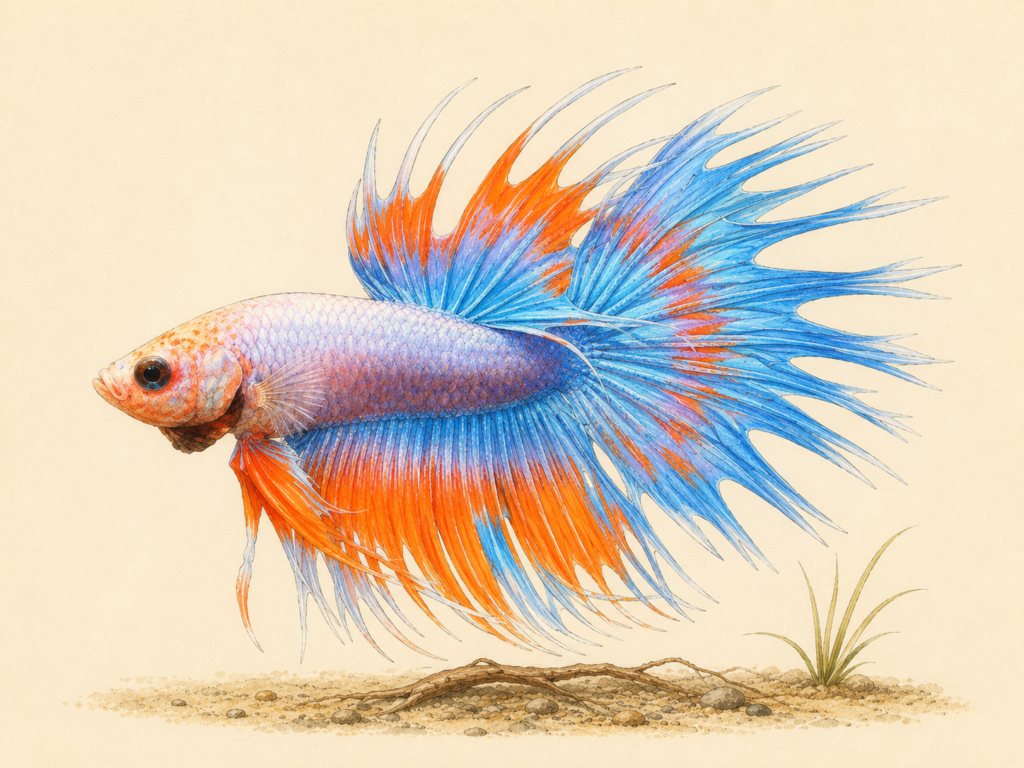
The Crowntail Betta’s appearance is defined almost entirely by its extraordinary finnage. In a typical betta, the fin rays are connected by a continuous membrane of webbing that creates smooth, flowing edges. In the Crowntail, this webbing is reduced by at least one-third – and in show-quality specimens, by two-thirds or more – leaving the individual rays to extend well beyond the webbing as pronounced, pointed projections. The visual effect is unmistakable: rather than the rounded, fan-like spread of a Halfmoon or the trailing drape of a Veiltail, the Crowntail’s fins form a jagged, spiky crown that gives the variety its name.
This reduced-webbing trait is expressed across all unpaired fins – the caudal (tail), dorsal, and anal fins. In high-quality Crowntails, even the pectoral fins may show some degree of extended raying, though this is less consistently selected for. The rays themselves can be single, double-split, or even cross-rayed, with each configuration producing a different visual density and texture. Single-ray Crowntails have a cleaner, more minimalist spiky look, while double-ray and cross-ray fish present a more complex, bushy appearance.
The body shape of a Crowntail is essentially the same as any other domestic betta – a compact, laterally compressed form with an upturned mouth adapted for surface feeding and air-breathing. Males are significantly more finnaged than females, though female Crowntails also display the characteristic reduced webbing and extended rays on a smaller scale. Males typically reach 6 to 7 cm in body length.
One genuinely practical point about Crowntail finnage is its structural resilience. Because the fins carry less webbing, there is simply less delicate membrane tissue to tear or damage. The rays themselves are semi-rigid and more robust than thin fin membrane. This means that Crowntails are measurably less susceptible to fin tears from minor snags, moderate current, or rough-edged decor than Halfmoon or Rosetail bettas, whose enormous webbed fins are notoriously fragile. This does not mean Crowntails are immune to fin damage – the extended ray tips can still curl, break, or develop issues in poor water quality – but the practical difference is real and meaningful for everyday care.
Crowntails are available in virtually every colour and pattern found in the domestic betta palette. Solid reds, blues, and blacks are common, as are bicolour combinations, marble patterns, butterfly markings, and metallic or dragon-scale overlays. The striking fin shape tends to be most visually dramatic in darker, high-contrast colours, where each individual ray is clearly defined against the gaps between them.
Varieties and Morphs
Within the Crowntail category, several sub-varieties are recognised by breeders and show judges, distinguished primarily by the structure of the fin rays themselves.
Single-ray Crowntail: The most common form. Each fin ray extends as a single, unbranched spike beyond the reduced webbing. This produces a clean, evenly spaced crown effect and is the most widely available type in pet shops.
Double-ray Crowntail: Each primary ray splits into two branches partway along its length, creating a forked or Y-shaped tip. This gives the fins a denser, more complex look while retaining the spiky silhouette. Double-ray Crowntails are generally considered more desirable in show circles and command slightly higher prices.
Cross-ray (or King Crowntail): The most elaborate sub-type. The rays not only split but also cross over one another, creating an intricate lattice-like pattern. True cross-ray Crowntails are relatively rare and highly sought after by collectors and competitive breeders. The term “King Crowntail” is sometimes used loosely in the trade for any particularly impressive specimen, so buyers should examine the fins closely rather than relying on labels alone.
Crowntail Plakat (CTPK): A cross between Crowntail and short-finned Plakat genetics, producing a fish with the Crowntail’s reduced webbing and extended rays but on much shorter fins overall. CTPKs are exceptionally hardy – combining the reduced tearing risk of both shorter fins and less webbing – and are increasingly popular among keepers who want the Crowntail look without the maintenance considerations of long finnage.
Half-Sun: A hybrid form that crosses Crowntail with Halfmoon genetics, aiming for the 180-degree spread of a Halfmoon but with slight ray extensions beyond the webbing. Half-Suns sit on a spectrum between the two parent types; specimens with more pronounced ray extensions lean towards Crowntail classification, while those with minimal extension are considered Combtails.
Combtail: Technically distinct from a true Crowntail, the Combtail has webbing reduced by less than one-third of the ray length, producing only slight extensions rather than dramatic spikes. Combtails are common in pet-shop stock and are often sold as Crowntails, though experienced keepers and breeders distinguish between the two. A true Crowntail should have webbing reduced by at least 33% of the ray length.
Colour-wise, Crowntails appear in every established betta colour variety, including solid, bicolour, multicolour, butterfly, marble, koi, galaxy, mustard gas, and metallic/dragon forms. The interaction between colour and fin structure is purely aesthetic.
Natural Habitat
As a selectively bred domestic variety, the Crowntail Betta has no natural habitat in the wild. However, understanding the native environment of wild Betta splendens remains essential for providing appropriate captive conditions, as the Crowntail’s physiology and behavioural instincts are unchanged from its wild ancestors.
Wild Betta splendens are native to central Thailand. Records from the remainder of southern peninsular Thailand and from the Mekong River basin in eastern Thailand, Laos, Vietnam, and Cambodia refer to other species or to introduced populations. They inhabit shallow, slow-moving or still waters including rice paddies, drainage ditches, roadside puddles, marshes, and the margins of ponds and streams. These habitats are characterised by warm temperatures, soft to moderately hard water, a slightly acidic to neutral pH, and heavy vegetation. The water is often shallow – sometimes only a few centimetres deep – and may be shaded by overhanging plants, resulting in relatively low light levels.
Crucially, these environments are almost always still or very gently flowing. Wild bettas are not adapted to cope with significant current, and this is even more relevant for the Crowntail variant. While the Crowntail’s reduced webbing makes it somewhat more hydrodynamic than a Halfmoon, the extended ray tips still create drag, and strong flow will stress the fish and may cause ray curling or breakage over time.
The substrate in wild betta habitats is typically muddy or silty, with dense growths of aquatic and emergent plants providing cover, territory markers, and surfaces for bubble nests. Leaf litter is frequently present, releasing tannins that tint the water a light amber and contribute to the slightly acidic conditions bettas prefer. Replicating these elements in the aquarium – particularly the still water, warmth, and abundant plant cover – creates the most comfortable and natural-feeling environment for any domestic betta, Crowntails included.
Tank Size and Setup
The minimum recommended tank size for a single Crowntail Betta is 41 litres. Larger tanks are easier to heat consistently, maintain stable water parameters, and allow for more aquascaping complexity – all of which benefit the fish. Bettas can survive in tiny containers, but they cannot thrive in them.
When setting up a tank specifically for a Crowntail, the primary consideration is decor safety. Although Crowntails are hardier-finned than Halfmoons or Rosetails, their extended ray tips can still catch on rough surfaces. Avoid sharp-edged plastic plants, rough-textured resin ornaments, and any decor with narrow openings or jagged edges. The classic “pantyhose test” remains a useful guideline: if fabric would snag on a surface, it could damage fin rays. Smooth driftwood, rounded stones, and live or high-quality silk plants are the safest choices.
That said, Crowntail keepers do have slightly more freedom than those keeping heavily webbed varieties. Moderate driftwood textures, mildly textured stone (such as river rock or smooth slate), and even some rougher natural materials that would be risky for a Halfmoon are generally acceptable for a Crowntail, as the reduced webbing means there is less tissue to catch and tear. This makes the Crowntail a forgiving choice for aquascapers who want to use natural hardscape without constant worry.
Live plants are strongly recommended. Dense planting provides visual barriers that reduce stress, offers resting spots near the surface, and contributes to water quality. Floating plants such as Salvinia, Ceratopteris (water sprite), or Amazon frogbit are particularly beneficial, as bettas naturally spend much of their time near the surface and appreciate the shade and cover floating vegetation provides. Mid-ground and background plants like Java fern, Anubias, and Cryptocoryne species are all excellent, low-maintenance choices that complement betta keeping well.
Lighting should be moderate. Bettas do not require intense light, and excessively bright illumination can stress them. If keeping live plants, choose a light that meets the plants’ needs but provide shaded areas via floating plants or tall stem plants. A consistent photoperiod of 8 to 10 hours per day is ideal.
A lid or cover is essential. All bettas are capable jumpers, and Crowntails are no exception. Ensure any openings for filter intakes, heater cables, or airline tubing are small enough to prevent escape. A small gap between the water surface and the lid is beneficial, as bettas breathe atmospheric air via their labyrinth organ and need access to a pocket of warm, humid air above the water.
Water Parameters
| Temperature | 24–30 °C |
| pH | 6.0–8.0 |
| General hardness (GH) | 1–15 dGH |
| Ammonia | 0 ppm |
| Nitrite | 0 ppm |
| Nitrate | Below 20 ppm |
The Crowntail Betta’s water parameter requirements are identical to those of any other domestic Betta splendens variant. Temperature stability is arguably the single most important factor – bettas are tropical fish that become stressed and lethargic if kept too cool. A reliable, adjustable heater is essential in all but the warmest climates.
One area where Crowntail-specific advice applies is water quality’s effect on fin condition. While Crowntail fins are structurally more robust than heavily webbed varieties, the exposed ray tips are still susceptible to curling, fraying, and erosion in suboptimal water conditions. Maintaining ammonia and nitrite at 0 ppm and nitrate below 20 ppm is particularly important for preserving the Crowntail’s distinctive fin shape. Water changes should be small and regular rather than large and intermittent.
Some experienced Crowntail keepers add Indian almond leaves (Catappa leaves) or similar botanical materials to their tanks. The mild tannins released lower pH slightly and create water conditions closer to the species’ ancestral habitat. While not strictly necessary, many keepers report improved fin condition and colouration with tannin-stained water. The leaves also provide surface cover that bettas appreciate.
Filtration and Equipment
Filtration for a Crowntail Betta should prioritise biological efficiency and gentle flow. Sponge filters are the most commonly recommended option for betta tanks and remain an excellent choice – they provide effective biological filtration with minimal current, are inexpensive, easy to maintain, and pose no risk of fin entanglement. Small internal filters and hang-on-back filters can also work well, provided their outflow is baffled or redirected to reduce current strength.
The Crowntail’s reduced webbing does give it a slight hydrodynamic advantage over Halfmoons and Rosetails, meaning it can tolerate marginally more flow without becoming exhausted. However, this advantage should not be overstated – Crowntails are still long-finned fish that will struggle in strong current. As a practical guideline, if you can see the fish being pushed by the flow or if it consistently avoids certain areas of the tank, the current is too strong. Adjustable-flow filters or simple baffles (a piece of filter sponge wedged over the outflow, or a pre-filter sponge on the intake) solve most flow issues easily.
An adjustable heater rated for the tank size is essential. Place the heater near the filter outflow to ensure even heat distribution. A separate thermometer (digital or glass – do not rely on the heater’s built-in thermostat alone) should be used to verify temperature accuracy.
An air pump is not required if using a sponge filter (which is air-driven) or another adequate filtration method. If used independently, keep airflow gentle to avoid excessive surface agitation. Bettas access atmospheric air and do not benefit from highly oxygenated water in the way that many other species do; excessive surface movement can actually make it harder for them to breathe comfortably at the surface.
A timer for the aquarium light helps maintain a consistent photoperiod and reduces the risk of algae overgrowth. Test kits for ammonia, nitrite, nitrate, and pH – preferably liquid-based kits rather than test strips, for greater accuracy – are important tools for ongoing monitoring.
Diet and Feeding
Crowntail Bettas are carnivorous, like all Betta splendens. Their diet should be based on high-quality betta-specific pellets or granules, supplemented regularly with frozen or live foods. There are no dietary differences between Crowntails and other betta varieties; the focus should be on variety, quality, and portion control.
A good-quality betta pellet with whole fish or insect meal as the first ingredient should form the staple diet. Feed 2 to 4 appropriately sized pellets twice daily – enough to be consumed within one to two minutes. Bettas have small stomachs (roughly the size of their eye) and are easily overfed, which leads to bloating, constipation, and water quality issues.
Supplementary foods should be offered two to three times per week. Frozen bloodworms, daphnia, brine shrimp, and mosquito larvae are all excellent choices. Live foods, where available, are even better – they stimulate natural hunting behaviour and are particularly useful for conditioning breeding pairs. Freeze-dried foods are acceptable as occasional treats but should be pre-soaked in tank water for a few minutes before feeding to prevent digestive issues caused by expansion in the stomach.
The Crowntail’s exposed ray tips make fin health particularly visible: well-fed Crowntails display straight, rigid rays with clean tips, while poorly conditioned fish may show ray curling or dull, brittle looking fins.
A fasting day once per week is widely recommended by experienced betta keepers to allow the digestive system to rest and reduce the risk of bloating. This is a standard practice for all betta varieties and is equally applicable to Crowntails.
Behaviour and Temperament
The Crowntail Betta shares the behavioural profile of all domestic Betta splendens: intelligent, territorial, and interactive. Males are famously aggressive towards other males of the same species and should always be housed individually or in carefully managed community setups (never with another male betta).
Anecdotally, many experienced keepers report that Crowntails tend towards the more assertive end of the betta temperament spectrum. While individual personality varies enormously and generalisations should be treated cautiously, there is a widely held view in the hobby that Crowntails and Plakats are somewhat feistier and more active than the more heavily finned Halfmoon and Rosetail types. Whether this is genuinely genetic or simply a consequence of their lighter fin load allowing more vigorous movement is debatable, but the practical result is the same: Crowntails tend to be active, engaged fish that patrol their territory with energy and readily interact with their keepers.
This relative activity level is one of the Crowntail’s genuine advantages over more elaborately finned varieties. Halfmoons and Rosetails are often weighed down by their massive fins, leading to lethargy, resting on the substrate, and reluctance to swim to the surface for food. Crowntails, with their lighter, less drag-inducing fin structure, move more freely and tend to use all levels of the tank. This makes them more engaging to watch and arguably leads to better quality of life.
Flaring behaviour – where the fish extends its gill covers and spreads all fins to maximum size as a territorial display – is particularly dramatic in Crowntails. The spiky fin silhouette creates an impressive threat display. Brief, controlled flaring, stimulated occasionally by a mirror held beside the tank, is useful exercise and enrichment, but prolonged or constant flaring causes chronic stress and should be avoided. If the fish can see its own reflection in the tank glass at all times, the glass may need repositioning or the background darkening.
Crowntails are curious fish that benefit from environmental enrichment. Rearranging decor occasionally, providing floating objects to investigate, and varying the feeding routine all help keep them mentally stimulated. They quickly learn to recognise their keeper and will often approach the front of the tank in anticipation of food or interaction.
Tank Mates
While Crowntail Bettas can be kept in community settings, careful species selection is essential. The Crowntail’s somewhat feistier temperament means tank mate choices should lean towards calm, non-flashy species that will neither provoke the betta nor be targeted by it. At the same time, the Crowntail’s relatively hardy fins mean you have slightly more flexibility with tank mates that produce mild current or are modestly active compared to keeping a Halfmoon in community. Any community tank housing a betta should be well-planted and offer ample visual barriers and hiding spots.
Good tank mates
- Pygmy Corydoras – Tiny, peaceful bottom-dwellers that stay well out of the betta’s preferred mid-to-upper zone and are too small and drab to provoke aggression.
- Amano Shrimp – Large enough to avoid being eaten by most bettas, these industrious algae eaters occupy a completely different ecological niche and are generally ignored.
- Kuhli Loach – Nocturnal, eel-shaped bottom-dwellers that hide during the day and are virtually invisible to a territorial betta, making conflict extremely unlikely.
- Ember Tetra – Small, peaceful, and lacking the flowing fins or bright colours that trigger betta aggression; keep in groups of six or more to maintain shoaling behaviour and reduce individual targeting.
- Ramshorn Snail – Hardy, unobtrusive snails that help with algae and detritus; their shell provides protection against the occasional curious nip.
- Harlequin Rasbora – A classic betta-compatible shoaling fish; their subdued colouration and peaceful nature make them reliable community partners.
- Malaysian Trumpet Snail – Burrowing snails that aerate the substrate and are almost entirely ignored by bettas due to their small size and nocturnal habits.
- Otocinclus – Small, algae-grazing catfish that stick to surfaces and rarely enter open water, posing no territorial threat; require groups of four or more and a mature tank with established biofilm.
Fish to avoid
- Male Betta (any variety) – Housing two male bettas together will result in severe aggression and likely death; this is non-negotiable regardless of tank size.
- Tiger Barb – Notorious fin nippers that will relentlessly target any betta’s fins, including the Crowntail’s extended rays.
- Paradise Fish – A closely related anabantoid with similar territorial instincts; aggression between the two species is virtually guaranteed.
- Angelfish – Territorial cichlids that grow much larger than bettas and can become aggressive, particularly in smaller tanks; their long fins may also trigger betta aggression.
- Chinese Algae Eater – Becomes increasingly aggressive and territorial with age and has a well-documented tendency to attach to and rasp the slime coat of slow-moving fish.
- Dwarf Gourami – Another anabantoid that occupies the same water column zone and may trigger territorial disputes; both species suffer from the stress of cohabitation.
- Serpae Tetra – A known fin-nipping species whose bold red colouration and nippy habits make it doubly problematic as a betta companion.
- Convict Cichlid – An aggressive Central American cichlid that will outcompete and potentially injure a betta; completely incompatible in temperament and size.
Breeding
Breeding Crowntail Bettas follows the same general process as breeding any domestic Betta splendens: the male constructs a bubble nest at the surface, the pair spawns in an embrace beneath it, and the male guards and tends the nest. The challenge for Crowntail breeders lies in selecting quality breeding stock and raising fry that develop well-formed, evenly spaced rays.
Both the male and female should ideally display strong Crowntail characteristics, with well-defined, deeply reduced webbing and straight, evenly spaced rays. Avoid fish with curled or crossed rays, uneven webbing reduction, or deformed spines. Condition both fish on high-protein foods such as live or frozen bloodworm and brine shrimp before spawning. A female in breeding condition will display a visibly swollen abdomen.
The breeding tank should be shallow and gently heated, with minimal or no filtration during spawning and the first days of fry development, and floating material for the male to anchor his bubble nest.
Although the pair need not be separated prior to spawning, some breeders keep the female in a jar or behind a divider at first, so the pair can see each other without contact, and release her once the male has built his nest.
The male will not usually tolerate the female in the vicinity until the nest is complete, and when she is ready to spawn, dark bars appear on her flanks. Spawning normally occurs beneath the nest in an embrace typical of the family, with the male wrapped around the female; milt and a few eggs are released at the point of climax, the female catches them between her pelvic fins and body, and the male transfers them to the nest while she recovers any loose eggs, the process repeating until the female is spent.
After spawning the adults can normally be left in the tank. The female is no longer actively involved, and the male assumes sole responsibility for guarding and tending the nest, continuing to collect and return any eggs that fall. Eggs typically hatch within 24 to 48 hours, and the fry remain in the nest for a further three to four days until the yolk sac is fully absorbed. Once the fry begin to swim freely, the male loses interest in the brood, and the adults do not usually eat their offspring.
Feed the fry an infusoria-grade food for the first few days, after which they can accept motile foods such as microworm and newly hatched brine shrimp (Artemia nauplii). There are reports of young Bettas developing health issues if fed excessive amounts of Artemia. Keep water changes small and regular. Fry growth rates vary, and the degree of webbing reduction varies across a spawn; not all fry will show the full Crowntail form, as genetics, nutrition, and water quality all influence fin development. Be prepared with grow-out containers and a plan for rehoming juveniles.
Common Diseases
Crowntail Bettas are susceptible to the same diseases as all domestic Betta splendens, with no variety-specific disease vulnerabilities. However, the Crowntail’s unique fin structure means that certain conditions manifest differently or deserve particular attention.
Fin rot is the most common health issue for any betta and warrants special mention for Crowntails. In heavily webbed varieties, fin rot typically presents as ragged, receding edges on the fin membrane. In Crowntails, because there is less webbing to erode, fin rot often manifests as darkening, curling, or erosion of the ray tips themselves. Early-stage ray tip erosion can be subtle – look for tips that appear blunted, darkened, or slightly curled rather than straight and pointed. Fin rot is commonly associated with poor water quality and is treated by correcting water conditions, keeping up regular water changes, and in persistent cases, using appropriate antibacterial medication.
Ray curling is a condition particularly associated with Crowntails where the extended ray tips curl inward or outward rather than remaining straight. Maintaining stable, clean water and a varied, high-quality diet supports straight, healthy rays.
Ich (white spot disease) is caused by the parasite Ichthyophthirius multifiliis and presents as small white cysts resembling grains of salt on the body and fins. Affected fish often clamp their fins and rub against surfaces. Treatment involves raising the temperature gradually to 28 to 30 °C, combined with aquarium salt or a proprietary ich medication.
FAQs
What is the minimum tank size for a Crowntail Betta?
The minimum tank size for a Crowntail Betta is 41 litres. The tank should be heated and filtered, and males must never be housed together.
Are Crowntail Betta fins more fragile than other betta types?
No, Crowntail Betta fins are actually hardier and less prone to tearing than varieties like the Halfmoon or Rosetail. Because Crowntails carry less webbing between their fin rays, there is less delicate membrane tissue to tear or snag. However, the extended ray tips can still curl, break, or develop issues in poor water quality, so good care is still essential.
Can I keep a Crowntail Betta with other fish?
Yes, Crowntail Bettas can be kept with carefully chosen, calm tank mates. However, males must never be housed with other male bettas. Always ensure any companions are peaceful species that will not nip at the betta’s fins or compete aggressively for territory.
What water temperature and pH does a Crowntail Betta need?
Crowntail Bettas thrive in water temperatures of 24-30 °C with a pH range of 6.0-8.0. General hardness should be kept at 1-15 dGH.
How long do Crowntail Bettas live?
Crowntail Bettas typically live 3-5 years with proper care. Providing a heated, filtered tank of adequate size, stable water parameters, and a good diet will help maximise their lifespan.
Related Guides
- Checkerboard Dwarf Cichlid – A peaceful dwarf cichlid that can make a suitable tank mate consideration for community setups with a Crowntail Betta in a larger tank.
- Elegant Corydoras – A calm bottom-dwelling species worth researching as a potential peaceful companion for a betta in an appropriately sized aquarium.
- Dwarf Pleco – A small, unobtrusive algae-eating catfish that occupies different tank zones and could coexist with a Crowntail Betta in a well-planned setup.
- False Bandit Corydoras – Another gentle corydoras species that stays near the substrate, making it a low-conflict option when considering betta tank mates.
- Blue-Striped Rivulus – A small surface-dwelling killifish whose care requirements overlap with those of Betta splendens, offering useful comparisons in tropical nano-tank husbandry.