Quick summary
The Alien Betta is a striking but demanding interspecies hybrid best suited to experienced keepers, as it is more aggressive, skittish, and stress-sensitive than a standard domestic betta, needs a 40 litre or larger tank with dense cover, and cannot usually be kept in female sororities. If you want a low-maintenance, easygoing betta or plan to house females together, this is probably not the right fish for you.
🐠 Build a tank around this species
In this guide:
- Introduction
- Quick Stats
- Appearance
- Varieties and Morphs
- Natural Habitat
- Tank Size and Setup
- Water Parameters
- Filtration and Equipment
- Diet and Feeding
- Behaviour and Temperament
- Tank Mates
- Breeding
- Common Diseases
- FAQs
Introduction
The Alien Betta is not simply another colour or fin variant of the domestic Betta splendens. It is a genuine interspecies hybrid, created by deliberately crossing domestic Betta splendens with one or more wild Betta species – most commonly Betta smaragdina, Betta imbellis, and Betta mahachaiensis. First developed by specialist Thai breeders around 2010, the Alien Betta occupies a unique position in the aquarium hobby, comparable in concept to the Flowerhorn Cichlid: a man-made hybrid that combines traits from multiple species to produce something genuinely distinct from either parent lineage.
What sets the Alien Betta apart from the hundreds of domestic betta varieties is more than skin deep. The infusion of wild-type genetics gives these fish a noticeably different body shape – sleeker, more streamlined, and less exaggerated than the heavily selected domestic forms. Their iridescent scaling, often covering the entire body in shimmering blues, greens, or coppers, reflects the spectacular metallic colouration found in their wild-species parentage. But perhaps the most significant differences are behavioural. Alien Bettas tend to be more aggressive, more skittish, and more unpredictable than their fully domestic counterparts, demanding a different approach to housing, tank mates, and general husbandry.
Because Alien Bettas share some baseline care requirements with domestic Betta splendens, readers who are new to keeping any type of betta may wish to read the full Betta Fish Care Guide for foundational information on topics such as cycling, water changes, and general betta biology. This guide focuses specifically on the ways in which Alien Bettas diverge from standard domestic betta care – and those differences are substantial enough to warrant careful attention.
Quick Stats
| Scientific name | Betta splendens hybrid (interspecies) |
|---|---|
| Common names | Alien Wild Betta, Hybrid Wild Betta |
| Family | Osphronemidae |
| Origin | Thailand (captive-bred hybrid; parent species from Thailand, Laos, Cambodia) |
| Adult size | 7 cm |
| Lifespan | 3–5 years |
| Difficulty | Intermediate |
| Breeding difficulty | Advanced |
| Temperature | 24–30 °C |
| pH | 6–8 |
| GH | 1–15 dGH |
| KH | 2–8 dKH |
| Minimum tank size | 40 L |
| Conservation status | Not Evaluated (captive-bred hybrid) |
Appearance
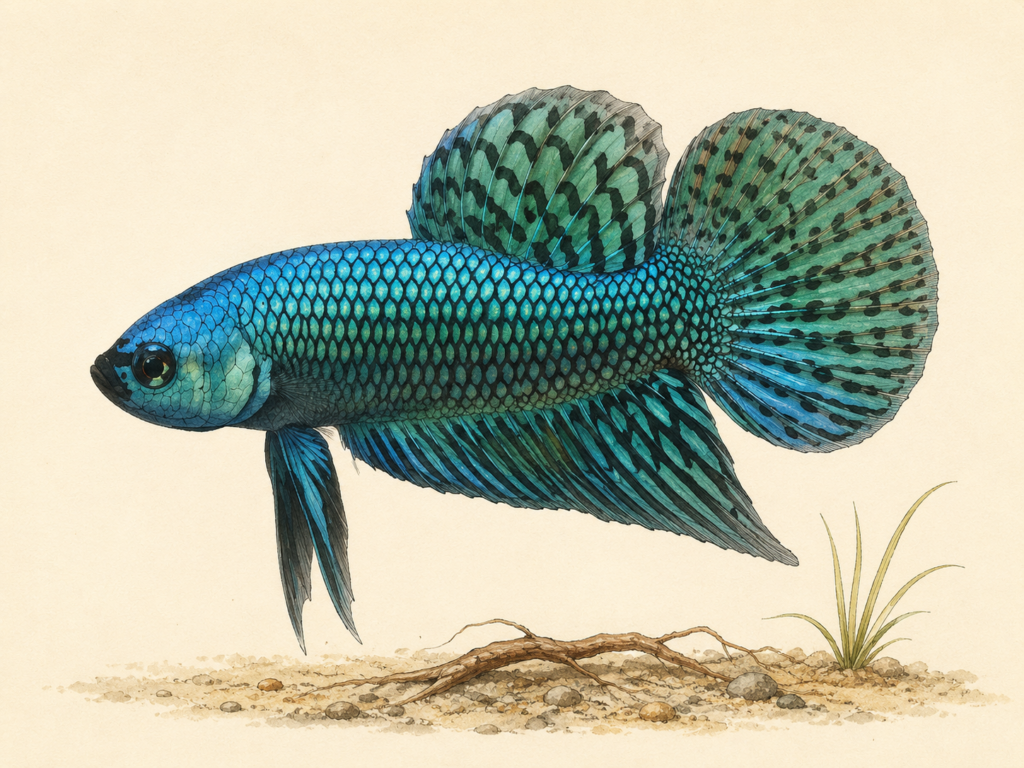
The most immediately striking feature of the Alien Betta is its intense, full-body iridescence. Unlike most domestic bettas, where metallic scaling may be concentrated on specific areas or layered over pigment-based colours, the Alien Betta typically displays a dense, almost armour-like sheen across the entirety of its body, gill plates, and fins. This iridescence is inherited from wild parent species – particularly Betta smaragdina and Betta mahachaiensis – and produces colours that shift dramatically under different lighting angles, ranging from electric blue and deep teal to emerald green and burnished copper.
The body shape of an Alien Betta is noticeably different from a standard domestic betta. The wild-type genetics produce a more streamlined, torpedo-shaped profile with a slimmer body and a less rounded head. The fins are typically short to medium in length, closer to a plakat or wild-type fin configuration than the long, flowing finnage seen in halfmoon or veiltail varieties. This shorter finnage is not a fault – it reflects the hybrid’s wild heritage and contributes to its exceptional agility and swimming speed.
The scales themselves tend to be well-defined and individually visible, each one catching and refracting light independently to create a mosaic-like shimmer. In high-quality specimens, this scaling extends onto the fins, producing an effect where the entire fish appears to glow. The gill plates are often particularly vivid, flaring outward to reveal brilliant metallic patches during displays of aggression or courtship.
Males are significantly more colourful and intense than females, though females also display more iridescence than their fully domestic counterparts. Males typically have slightly longer ventral and anal fins, a more pronounced jaw, and a generally bolder presence. Females tend to be slightly smaller, with a visible ovipositor (egg spot) near the ventral fin, though distinguishing sex in juvenile Alien Bettas can be challenging as both sexes show strong colour early on.
The eyes of Alien Bettas are often darker than those of domestic bettas, sometimes appearing almost black, which is another wild-type trait. Their overall posture tends to be more alert and reactive, with a readiness to dart or flare that reflects their wilder temperament.
Varieties and Morphs
Because the Alien Betta is a hybrid rather than a single standardised breed, there is considerable variation depending on which wild species were used in the cross and how many generations of selective breeding have taken place. Several recognised colour lines have emerged within the Alien Betta category, each reflecting a different combination of parent species genetics and selective refinement.
Wild Alien Blue is perhaps the most commonly encountered form. These fish display an intense, deep blue iridescence that covers the body, fins, and gill plates. The blue ranges from a vivid royal shade to a darker, almost midnight tone depending on the lighting and the individual specimen. This colour line often incorporates Betta smaragdina genetics most prominently.
Wild Alien Copper specimens exhibit a warm, metallic copper or bronze sheen across the body. Under certain lighting, the copper tones can shift toward gold or reddish-brown. This colour line is visually distinct from the blue forms and is particularly valued for its warm, rich tones that are relatively uncommon among domestic bettas. The copper colouration is often linked to Betta mahachaiensis parentage.
Green Alien bettas display an emerald to teal green iridescence. These are sometimes the most dramatically colour-shifting of all the Alien lines, appearing blue-green under white light, deep green under warmer light, and almost turquoise at certain angles. Green Alien specimens with highly uniform scaling are considered especially desirable.
Beyond these primary colour lines, breeders have also produced various intermediate forms and multi-tonal specimens where blue, green, and copper elements blend across the body. Some breeders are working on darker base colours to intensify the contrast of the metallic scaling, while others are selecting for broader fin spread while maintaining the wild-type body shape.
It is worth noting that quality varies considerably between breeders and sources. Not all fish sold as “Alien Bettas” are genuine interspecies hybrids – some are simply heavily metallic domestic bettas marketed under the Alien label. Genuine Alien Bettas should display the characteristic wild-type body shape, short to moderate finnage, and the distinctive full-body iridescence that distinguishes them from domestic metallic lines.
Natural Habitat
As a captive-bred hybrid, the Alien Betta does not have a natural habitat of its own. However, understanding the environments of its parent species provides essential context for replicating appropriate conditions in captivity.
Betta smaragdina, one of the primary wild parent species, inhabits the shallow rice paddies, marshes, and floodplain pools of north-eastern Thailand and Laos. These environments are characterised by warm, soft to moderately hard water with dense vegetation, a layer of leaf litter on the substrate, and minimal current. The water is often slightly acidic to neutral, stained with tannins from decomposing organic matter.
Betta imbellis, the “peaceful betta,” occupies similar lowland habitats across southern Thailand, peninsular Malaysia, and parts of Indonesia. Its habitats tend to be heavily vegetated shallow waters – ditches, swamp margins, and slow-moving streams – with very soft, acidic water and subdued lighting filtered through overhanging vegetation.
Betta mahachaiensis is native to a remarkably specific habitat: the coastal areas around Samut Sakhon province near Bangkok, where it inhabits brackish to slightly saline waters among nipa palm roots and mangrove-adjacent pools. This species tolerates a wider range of hardness and pH than many other wild Betta species, a trait that is sometimes passed on to its Alien Betta offspring.
The common threads across all three parent species’ habitats are warm temperatures, shallow water with access to the surface for labyrinth breathing, abundant cover in the form of vegetation and leaf litter, and minimal water flow. Alien Bettas, having inherited a blend of these adaptations, generally thrive in setups that mimic these conditions: warm, well-planted tanks with gentle filtration, low to moderate flow, and plenty of visual barriers and hiding spots.
The wild-type genetics also mean that Alien Bettas retain stronger instincts for seeking cover and reacting to perceived threats than fully domesticated bettas, which is a critical consideration when designing their environment.
Tank Size and Setup
While domestic bettas can be maintained in tanks as small as 20 litres, Alien Bettas benefit meaningfully from more space. A minimum tank size of 40 litres is recommended for a single Alien Betta, and larger is always better. The additional space is not merely a welfare consideration – it serves a practical function in managing the hybrid’s heightened skittishness and territorial behaviour. In a cramped tank, an Alien Betta is more likely to remain stressed, display pale colours, and dart erratically when startled.
The aquascape should prioritise dense planting and visual barriers. Unlike many domestic bettas that are content to rest on broad leaves near the surface, Alien Bettas actively use cover throughout the water column. Tall stem plants such as Vallisneria, Hygrophila, and Rotala provide excellent mid-water cover, while floating plants such as Salvinia, Amazon frogbit, or red root floaters diffuse overhead light and create a sense of security. The subdued lighting that floating plants provide closely replicates the dappled conditions of their parent species’ habitats and helps reduce stress-related behaviours.
Hardscape elements such as driftwood, smooth rocks, and coconut shell hides offer additional refuge points. Avoid sharp or rough decorations that could damage the fish’s scales during their characteristically fast, darting movements. Indian almond leaves (Terminalia catappa) are an excellent addition, releasing tannins that soften the water, lower pH slightly, and provide antibacterial properties – all of which replicate conditions their wild-type parent species have evolved to thrive in.
A secure, tight-fitting lid is essential. Alien Bettas are significantly more prone to jumping than domestic bettas. Their wild-type instincts include leaping to escape predators or move between bodies of water, and even a seemingly content Alien Betta can jump if startled by sudden movements, vibrations, or changes in lighting. Ensure there are no gaps around filter intakes, heater cables, or other equipment.
Substrate choice is largely a matter of personal preference, though dark substrates tend to bring out the best colour in Alien Bettas by reducing reflected light and encouraging the fish to display deeper, more saturated iridescence. Fine gravel or aquarium sand in dark brown or black tones works well and supports planted setups effectively.
Water Parameters
| Temperature | 24–30 °C |
| pH | 6.0–8.0 |
| General hardness (GH) | 1–15 dGH |
| Carbonate hardness (KH) | 2-8 dKH |
| Ammonia | 0 ppm |
| Nitrite | 0 ppm |
| Nitrate | Below 20 ppm |
Alien Bettas are somewhat more tolerant of a range of water conditions than some wild Betta species, likely owing to the Betta splendens genetics in their lineage. However, they are less forgiving than fully domestic bettas when conditions slip outside acceptable ranges. The wild-type component of their genetics means they are more susceptible to stress from poor water quality, which can manifest as colour loss, clamped fins, increased skittishness, and heightened disease susceptibility.
Temperature stability is particularly important. While Alien Bettas can tolerate brief fluctuations, sustained temperatures below 24 °C will suppress their immune system and metabolism, while temperatures consistently above 28 °C can increase aggression and accelerate metabolic waste production. A reliable, adjustable heater is a non-negotiable piece of equipment for all but the warmest climates.
The pH range of 6.0-7.5 reflects the diversity of the parent species’ natural environments. Alien Bettas with strong Betta mahachaiensis influence may tolerate slightly higher pH and hardness, while those with more Betta imbellis genetics may prefer softer, more acidic conditions. If you know the parentage of your specific fish, tailoring water parameters accordingly can yield better results. In the absence of that information, aiming for a pH of 6.5-7.0 with moderate hardness represents a reliable middle ground.
Regular water changes of 20-25% weekly are advisable, using a dechlorinator and matching the replacement water’s temperature to the tank. Alien Bettas are more reactive to sudden parameter swings than domestic bettas, so large, infrequent water changes should be avoided in favour of smaller, more consistent ones.
The use of Indian almond leaves, alder cones, or other natural tannin sources is strongly recommended. These botanicals not only condition the water in ways that benefit the fish physiologically but also produce the tea-stained, amber-tinted water that closely replicates wild conditions and visually calms many Alien Bettas.
Filtration and Equipment
Filtration for an Alien Betta tank must balance effective biological and mechanical filtration with minimal water flow. Like all anabantoids, Alien Bettas are not strong swimmers in terms of sustained effort against current, and their wild-type startle response means that strong flow can cause chronic stress as the fish repeatedly darts away from the current’s push.
Sponge filters are an excellent choice for Alien Betta tanks. They provide gentle, consistent biological filtration, create minimal surface disturbance, and pose no risk of trapping the fish. An air-driven sponge filter rated for the tank’s volume will handle the bioload of a single Alien Betta comfortably. For planted tanks or setups with tank mates that increase the bioload, a small internal filter or hang-on-back filter with the flow turned down or baffled with a sponge can work well.
If using a hang-on-back or canister filter, ensure the outflow is diffused or directed against the glass to break up the current. Some keepers attach a piece of filter sponge over the outflow nozzle to achieve this. The goal is a gentle circulation that maintains water quality without creating directional flow strong enough to push the fish around.
A heater is essential in most climates. Choose an adjustable heater rated appropriately for the tank volume – typically 25-50 watts for a 40-litre tank. Position it near the filter outflow to distribute heat evenly. A separate thermometer (digital or glass) provides an independent check on the heater’s accuracy, which is important given that thermostat failures can cause rapid temperature swings.
Lighting should be moderate to subdued. Alien Bettas, owing to their wild-type heritage, are more comfortable under lower light levels than many domestic bettas. Bright overhead lighting without floating plant cover can cause persistent stress and colour washing. LED fixtures with adjustable intensity or a timer that provides a consistent photoperiod of 8-10 hours work well. The iridescent scaling of Alien Bettas actually looks most spectacular under moderate, slightly angled lighting rather than intense direct overhead illumination.
An air pump connected to the sponge filter typically provides sufficient surface agitation for gas exchange. Additional airstones are unnecessary and may create more turbulence than the fish appreciates.
Diet and Feeding
Alien Bettas are carnivorous, like all members of the Betta genus, but their wild-type heritage often makes them more enthusiastic hunters and more discerning about food quality than domestic bettas. Many Alien Bettas show a strong preference for live and frozen foods over pellets, particularly when first acquired.
A varied diet is the foundation of good health and colour development. High-quality betta pellets with a protein content of 40% or higher can form the staple diet for individuals that accept them. Brands that use whole fish or insect meal as primary ingredients are preferable to those based on fillers and plant proteins. Feed 2-3 pellets twice daily as a baseline, adjusting based on the individual’s size and appetite.
Frozen foods should be offered several times per week to supplement or replace pellets. Bloodworms, daphnia, brine shrimp, and mosquito larvae are all eagerly accepted. Frozen foods should be thawed in a small amount of tank water before feeding to avoid temperature shock to the fish’s digestive system and to prevent uneaten frozen chunks from fouling the water.
Live foods are where Alien Bettas truly come alive. The hunting instinct inherited from their wild parent species means they respond to live foods with an intensity and focus that domestic bettas rarely match. Live daphnia, baby brine shrimp (Artemia nauplii), wingless fruit flies, and blackworms all make excellent enrichment foods. Culturing live daphnia or brine shrimp at home is straightforward and provides a reliable supply of nutritionally excellent food that also engages the fish’s natural foraging behaviour.
One notable difference from domestic bettas is that some Alien Bettas can be reluctant to accept dry foods, particularly when first brought home. If your Alien Betta refuses pellets initially, offer frozen or live foods exclusively for the first week or two, then gradually introduce pellets alongside the preferred foods. Most individuals will learn to accept pellets over time, though some stubbornly refuse and may need to be maintained on a frozen and live food diet permanently.
Fasting one day per week is beneficial for digestive health and mirrors the intermittent feeding patterns these fish’s wild ancestors would have experienced. Overfeeding is a common issue and can lead to bloating, constipation, and water quality degradation. An Alien Betta’s stomach is roughly the size of its eye – a useful visual reference for portion sizing.
Behaviour and Temperament
This is arguably the section where Alien Bettas diverge most dramatically from domestic Betta splendens, and it is the area most likely to catch unprepared keepers off guard. Alien Bettas are generally more aggressive, more territorial, and significantly more skittish than standard domestic bettas. These behavioural traits are directly attributable to the wild-species genetics in their lineage.
Males are intensely territorial and should always be housed individually, as with domestic betta males. However, the aggression of Alien Betta males tends to be more persistent, more intense, and harder to redirect than in domestic bettas. An Alien Betta male will often patrol his territory more actively, flare more frequently and for longer durations, and respond more aggressively to perceived threats – including his own reflection, movements outside the tank, and even changes in decor.
The skittishness of Alien Bettas is a particularly important trait to understand and accommodate. Domestic bettas have been bred for generations to be tolerant of human activity, bright lights, and busy environments. Alien Bettas retain the flight response of their wild parent species. They may bolt at sudden movements near the tank, darting into cover or even attempting to jump. This behaviour typically diminishes over time as the fish acclimatises to its environment and keeper, but it rarely disappears entirely. Placing the tank in a relatively calm area of the home, away from high-traffic zones and loud equipment, helps significantly.
A critical point for prospective keepers: female Alien Bettas often cannot be kept together in sorority-style setups. This is a major departure from domestic betta keeping, where female sororities – though always requiring careful management – are a common and often successful approach. The wild-type aggression in Alien Betta females frequently makes sororities unstable, with dominant females harassing or injuring subordinates. Each female Alien Betta should generally be treated as an individual requiring her own territory, similar to a male.
Alien Bettas are highly intelligent fish that display complex exploratory behaviours when provided with an enriching environment. They investigate new objects, learn to recognise their keeper and associate them with food, and often develop individual quirks and preferences. Providing environmental enrichment through rearranging decor occasionally, offering live foods that require hunting, and adding floating objects to investigate can help keep these mentally active fish stimulated.
When flaring, Alien Bettas often display a more intense and dramatic colour transformation than domestic bettas, with their iridescent scaling seeming to intensify as the fish extends its gill plates and fins. This display is a natural and healthy behaviour in moderation, but persistent flaring – such as at a constant reflection – should be addressed by blocking the source, as chronic stress from prolonged displays can compromise health.
Tank Mates
Selecting tank mates for Alien Bettas requires more caution than for domestic bettas. The heightened aggression and territorial nature of these hybrids, combined with their increased stress sensitivity, mean that many species commonly kept with domestic bettas may not be suitable companions. Success depends heavily on tank size – a 40-litre tank is the minimum for a solitary Alien Betta, but if tank mates are desired, 60 litres or more is strongly recommended to provide adequate territory for all occupants. Dense planting and visual barriers are essential in any community setup to break lines of sight and provide escape routes.
Good tank mates
- Pygmy Corydoras – These tiny, bottom-dwelling catfish occupy a completely different zone to the Alien Betta and are too small and unobtrusive to trigger territorial aggression.
- Kuhli Loach – Their nocturnal, burrowing nature means they rarely interact with an Alien Betta, making cohabitation peaceful in well-planted tanks.
- Amano Shrimp – Large enough to avoid being treated as food by most Alien Bettas, these shrimp provide useful algae control and typically stay out of the betta’s way.
- Ember Tetra – Their small size, drab orange colouration, and tight schooling behaviour make them unlikely targets for aggression, though a group of at least eight is needed.
- Malaysian Trumpet Snail – These burrowing snails are virtually invisible to the betta during the day and provide beneficial substrate aeration.
- Clown Pleco – A small, nocturnal pleco that stays attached to driftwood and poses no territorial challenge, suitable in tanks of 80 litres or more.
- Celestial Pearl Danio – Peaceful, small, and generally occupying mid-water areas among plants, these danios coexist well provided there is adequate cover.
- Ramshorn Snail – Hardy and unobtrusive, ramshorn snails help with algae and detritus without provoking any interest from the betta.
Fish to avoid
- Other Betta Species or Hybrids – Any other betta, whether male or female, will almost certainly trigger severe aggression and fighting.
- Dwarf Gourami – As a fellow anabantoid, dwarf gouramis are likely to be perceived as rivals and attacked relentlessly.
- Tiger Barb – Notorious fin nippers that will harass the betta, and their active, boisterous schooling behaviour will stress a skittish Alien Betta.
- Paradise Fish – Another aggressive anabantoid that will compete for territory and likely injure or be injured by the Alien Betta.
- Fancy Guppy – Their flowing tails and bright colours make them likely targets for aggression, and Alien Bettas are even more likely to attack them than domestic bettas.
- Angelfish – Too large, too territorial, and too likely to either bully or be bullied by the Alien Betta depending on size differences.
- Cherry Shrimp – While sometimes kept with domestic bettas, Alien Bettas’ stronger hunting instincts mean cherry shrimp are very likely to be pursued and eaten.
- Plakat Betta – Housing any other betta variant alongside an Alien Betta is a recipe for serious injury or death to one or both fish.
Breeding
Breeding Alien Bettas is a more complex and unpredictable endeavour than breeding domestic Betta splendens, owing to the hybrid nature of these fish and the more intense behavioural dynamics inherited from their wild parent species. It is classified as difficult and is best attempted by experienced keepers who have successfully bred domestic bettas or wild-type Betta species previously.
The first challenge is pairing. Alien Betta males are exceptionally aggressive toward females outside of breeding condition, and even females in breeding condition may be attacked if the male is not receptive. Conditioning both fish separately for two to three weeks on a diet rich in live and frozen foods is essential. The female should be visibly plump with eggs, displaying vertical breeding bars on her flanks, before any introduction is attempted.
A dedicated breeding tank of at least 40 litres should be set up with shallow water – around 12-15 cm deep – a gentle sponge filter, a heater maintaining 26-28 °C, and plenty of floating plants or a piece of polystyrene sheet to support a bubble nest. Indian almond leaves are strongly recommended, as the tannins condition the water and the leaves themselves provide surfaces for the male to anchor his bubble nest.
Introduce the female in a clear container or behind a divider within the breeding tank, allowing visual contact without physical access. The male should begin building a bubble nest within a day or two if conditions are right. Once the nest is well-developed and the female is displaying receptive behaviour – vertical bars, a head-down posture, and attempts to approach the male – she can be released.
Close observation during the first hours after release is critical. Alien Betta breeding embraces can be rougher than those of domestic bettas, and the male may be excessively aggressive. If the female is being chased relentlessly without any wrapping behaviour occurring, or if she sustains significant fin or body damage, separate them immediately and try again after further conditioning.
Successful spawning follows the typical betta pattern: the male wraps around the female in a T-shaped embrace, squeezing eggs from her body, then collects the fallen eggs and places them in the bubble nest. This process repeats over several hours. After spawning is complete, remove the female, as the male will guard the nest and may attack her if she remains.
The male tends the nest diligently, retrieving fallen eggs and adding bubbles. Eggs hatch in approximately 24-48 hours, and the fry become free-swimming around three days after hatching. Remove the male at this point. Free-swimming fry should be fed infusoria or liquid fry food for the first few days, transitioning to freshly hatched brine shrimp nauplii as they grow. Fry growth rates can be variable, and sorting by size may be necessary to prevent larger siblings from cannibalising smaller ones – a trait that emerges earlier and more aggressively in Alien Betta fry than in domestic betta fry.
A key consideration is that breeding Alien Bettas can produce offspring with variable traits, particularly if the parent fish are themselves early-generation hybrids with a complex genetic background. Colour, body shape, and temperament may vary considerably within a single spawn. Specialist breeders select carefully across multiple generations to stabilise desired traits.
Common Diseases
Alien Bettas are susceptible to the same diseases as domestic bettas, but their wild-type genetics introduce some nuances in disease prevalence and treatment response that keepers should be aware of.
Fin rot is less commonly a major issue in Alien Bettas than in long-finned domestic varieties, simply because their shorter fins provide less surface area for bacterial colonisation and are less prone to mechanical damage. However, fin rot can still occur in poor water conditions and should be treated promptly with antibacterial medications and improved water quality.
Ich (white spot disease), caused by the protozoan Ichthyophthirius multifiliis, affects Alien Bettas in the same manner as other freshwater fish. The characteristic white cysts appear on the body and fins, and the fish may flash against objects in the tank. Treatment involves raising the temperature gradually to 28-30 °C and administering a proprietary ich treatment. Alien Bettas tend to respond well to heat-based treatment protocols.
Velvet disease (Piscinoodinium pillulare) is a particular concern for Alien Bettas and all Betta species. This parasitic infection produces a fine, gold or rust-coloured dusting on the body that can be difficult to detect against the iridescent scaling of an Alien Betta until the infection is advanced. Using a torch at an angle to the fish in a darkened room can help reveal the characteristic shimmer of velvet parasites. Treatment requires a copper-based medication and darkening the tank, as the parasite has a photosynthetic phase in its life cycle.
Stress-related illness is arguably more significant in Alien Bettas than in domestic bettas. The heightened stress sensitivity inherited from wild parent species means that environmental stressors – poor water quality, inappropriate tank mates, excessive light, vibrations, or sudden changes – can suppress the immune system more rapidly and more severely than in domestic bettas. Many health issues in Alien Bettas can be traced back to chronic low-level stress rather than a specific pathogen, making environmental optimisation the most important preventive medicine.
Swim bladder disorder can occur, typically related to overfeeding, constipation, or temperature fluctuations. Fasting for 24-48 hours followed by offering a small amount of thawed frozen daphnia (which has a mild laxative effect) often resolves mild cases. Persistent swim bladder issues may indicate an underlying bacterial infection requiring medication.
Columnaris (cotton wool disease) presents as white or grey fuzzy patches on the body or fins and can progress rapidly in warm water. It is bacterial in origin and requires antibiotic treatment. Alien Bettas with compromised immune systems from stress are particularly vulnerable.