Quick summary
The Peacock Eel suits moderately experienced aquarists who can provide a secure, well-covered tank with a fine sand substrate and are willing to feed live or frozen foods regularly. It is not ideal for beginners seeking an easy fish, as it demands pristine water quality, escape-proof lids, and patience with fussy feeding habits.
🐠 Build a tank around this species
In this guide:
- Introduction
- Quick Stats
- Appearance
- Natural Habitat
- Tank Size and Setup
- Water Parameters
- Filtration and Equipment
- Diet and Feeding
- Behaviour and Temperament
- Tank Mates
- Breeding
- Common Diseases
- FAQs
Introduction
The Peacock Eel is one of the most captivating and distinctive freshwater fish available in the aquarium trade. With its elongated, snake-like body, charming pointed snout, and striking row of eyespot markings along its dorsal ridge, this species has earned a devoted following among aquarists seeking something a little different from the usual community fish. Despite its common name, it is not a true eel at all but rather a member of the spiny eel family, Mastacembelidae, a group of fascinating bottom-dwelling fish found throughout South and Southeast Asia.
While Peacock Eels are sometimes marketed as beginner-friendly oddball fish, they do come with certain husbandry requirements that demand a degree of experience and preparation. Their preference for live and frozen foods, their sensitivity to water quality, and their remarkable ability to escape from seemingly secure tanks mean that prospective keepers need to do their homework before bringing one home. That said, for the aquarist willing to meet their needs, Peacock Eels reward their keepers with years of endearing behaviour, from burying themselves in sand with just their snout protruding to emerging at dusk to gracefully hunt along the substrate.
This guide covers everything you need to know to provide excellent care for the Peacock Eel, from tank setup and diet to compatible tank mates and breeding considerations.
Quick Stats
| Scientific name | Macrognathus siamensis |
|---|---|
| Common names | Siamese Spiny Eel, Spot-Finned Spiny Eel, Peacock Spiny Eel |
| Family | Mastacembelidae |
| Origin | Southeast Asia (Thailand, Laos, Cambodia, Vietnam, Myanmar) |
| Adult size | 25 cm |
| Lifespan | 8–18 years |
| Difficulty | Intermediate |
| Breeding difficulty | Advanced |
| Temperature | 23–28 °C |
| pH | 6–7.5 |
| GH | 5–15 dGH |
| KH | 3–10 dKH |
| Minimum tank size | 150 L |
| Conservation status | Least Concern (IUCN) |
Appearance
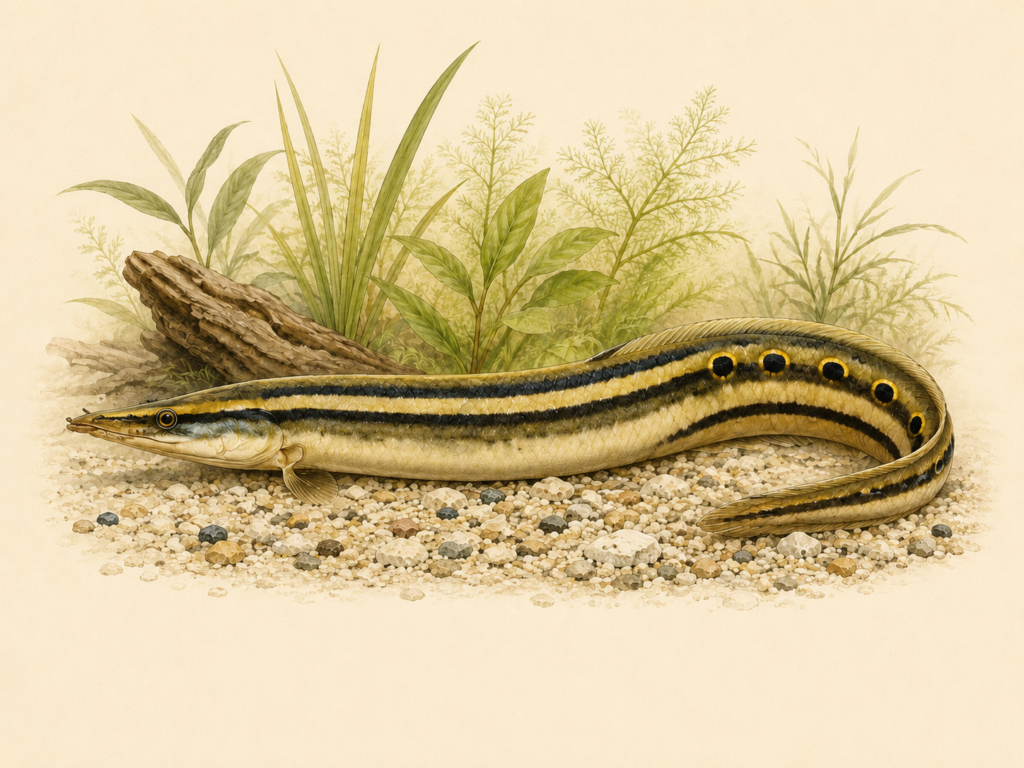
The Peacock Eel possesses the classic elongated, laterally compressed body shape common to all spiny eels. Its body tapers elegantly from a moderate midsection to a narrow, pointed tail, and the head ends in a distinctive elongated snout tipped with a small, fleshy, tubular nose, a sensory organ used to probe the substrate for buried invertebrates. The eyes are relatively small and positioned high on the head, giving the fish a permanently inquisitive expression.
The base colouration is typically a warm tan, olive-brown, or light golden-brown, which can shift subtly depending on the fish’s mood, health, and the substrate colour in its environment. A pale cream or yellowish stripe often runs along the lateral line from behind the gill cover to the base of the tail, and the belly is generally lighter, sometimes almost white. The most striking feature, and the one responsible for the common name, is the series of large, dark-ringed ocelli, or eyespots, that adorn the upper portion of the dorsal fin and the soft dorsal area near the caudal peduncle. These eyespots are typically dark brown or black with a pale golden or greenish centre, strikingly reminiscent of the “eyes” found on a peacock’s tail feathers. The number of eyespots can vary between individuals, typically ranging from three to six on each side.
The dorsal fin is preceded by a row of short, sharp spines, the feature that gives the spiny eel family its name. These spines are individually erectile and serve as a defensive mechanism against predators. The dorsal, caudal, and anal fins are often somewhat translucent with fine patterning. Males and females are difficult to distinguish visually, though mature females tend to be slightly thicker-bodied when viewed from above, particularly when gravid. Most specimens offered in the trade are juveniles measuring around 8–12 cm, but they will grow steadily over the first two to three years to reach their adult size of 20–30 cm.
Natural Habitat
Peacock Eels are native to the lowland freshwater systems of mainland Southeast Asia, where they inhabit slow-moving rivers, streams, canals, flooded plains, and the margins of lakes and reservoirs. Their range spans much of Thailand, Laos, Cambodia, Vietnam, and parts of Myanmar, and they are commonly found in the Mekong and Chao Phraya river basins. These are warm, tropical waterways with soft to moderately hard water and a slightly acidic to neutral pH.
In the wild, Peacock Eels are strongly associated with areas featuring sandy or muddy substrates where they can bury themselves during the day. They are typically found among submerged vegetation, root tangles, fallen branches, and other structural refuges along the banks and margins of waterways rather than in the open channel. The water in these habitats is often tannin-stained and relatively turbid, with gentle currents and abundant leaf litter on the bottom. Aquatic and marginal plants provide additional cover, and the substrate is rich with the small invertebrates, insect larvae, worms, and crustaceans, that form the bulk of the Peacock Eel’s natural diet.
Understanding this natural environment is key to replicating appropriate conditions in captivity. The species has evolved to spend much of its time buried or hidden, venturing out primarily at dawn, dusk, and during the night to forage. Bright, exposed aquariums with coarse gravel substrates and no hiding places will stress these fish considerably and can lead to health problems, loss of colour, and a drastically shortened lifespan.
Tank Size and Setup
A single Peacock Eel requires a minimum tank volume of 150 litres, with a preference for tanks that prioritise floor space over height. A tank measuring at least 100 cm in length is advisable, as these are active, if somewhat secretive, fish that appreciate room to patrol the bottom during their evening foraging sessions. If you wish to keep more than one Peacock Eel, or if housing them in a larger community, a tank of 250 litres or more is strongly recommended to reduce territorial stress and provide adequate hiding places for all inhabitants.
The single most important element of the Peacock Eel’s setup is the substrate. Fine, smooth sand is essential, not optional. These fish spend a significant proportion of their time buried in the substrate with only their snout and eyes exposed, and coarse gravel or sharp-edged substrates can abrade their delicate skin, leading to infections and considerable distress. Play sand, pool filter sand, or purpose-sold aquarium sand in a natural colour are all excellent choices. A substrate depth of at least 5–7 cm allows for comfortable burrowing behaviour.
Beyond the substrate, the tank should be furnished with abundant hiding places. Driftwood, bogwood, smooth river rocks, coconut shells, and lengths of PVC pipe all make excellent retreats. Dense plantings of robust species such as Java Fern, Anubias, Vallisneria, and Cryptocoryne provide additional cover and help diffuse light, which Peacock Eels prefer to be subdued. Floating plants are an excellent addition, as they dim the lighting naturally and encourage the fish to emerge earlier in the evening.
Escape prevention is a serious consideration with all spiny eels, and the Peacock Eel is no exception. These fish are astonishingly adept at finding and exploiting even the smallest gaps in tank lids. Every opening, including those around filter intakes, heater cables, and airline tubing, must be sealed with foam, sponge, or tightly fitting covers. A well-fitting glass or acrylic lid with no gaps larger than a few millimetres is non-negotiable. Many keepers have lost spiny eels to escape, often finding them dried out on the floor the following morning, so this point cannot be overstated.
Water Parameters
Peacock Eels are reasonably adaptable within their preferred range, but they are notably sensitive to poor water quality, particularly elevated ammonia, nitrite, and nitrate levels. They are scaleless or have only very reduced scales embedded in the skin, which makes them more susceptible to toxins dissolved in the water compared to fully scaled fish. Maintaining pristine water conditions through regular water changes and efficient filtration is therefore critical to long-term success.
| Temperature | 23–28 °C |
| pH | 6.0–7.5 |
| General hardness (GH) | 5–15 dGH |
| Carbonate hardness (KH) | 3–10 dKH |
| Ammonia | 0 ppm |
| Nitrite | 0 ppm |
| Nitrate | Below 20 ppm |
Aim for a stable temperature around 25–26 °C for general keeping. Sudden temperature swings should be avoided, and water changes should be carried out with temperature-matched, dechlorinated water. Weekly water changes of 20–30% are a sensible routine, though the exact frequency will depend on stocking levels and filtration capacity. Because of their sensitivity, it is wise to use a high-quality dechlorinator that also neutralises heavy metals, and to avoid any medications containing copper, which is toxic to spiny eels at doses that other fish tolerate without difficulty.
Filtration and Equipment
Good filtration is essential for Peacock Eels, but the flow rate should be moderate rather than vigorous. In the wild, these fish occupy calm, marginal waters and will become stressed by strong currents that buffet their elongated bodies. A canister filter rated for the tank’s volume, or slightly above, is generally the best choice, as it provides excellent biological and mechanical filtration while allowing the outflow to be diffused with a spray bar or lily pipe to reduce current strength. Hang-on-back filters can also work well in smaller setups, though the intake should be fitted with a pre-filter sponge to prevent the eel from becoming trapped or injured.
Internal sponge filters offer gentle flow and excellent biological filtration, making them a viable option particularly as supplementary filtration. If using an internal power filter, position the outlet so that it does not create a direct jet across the main living areas of the tank. Regardless of filter type, ensure that all intake tubes and overflow slots are securely covered or screened, as Peacock Eels will investigate and attempt to enter any opening they can fit their snout into.
A reliable, adjustable heater is necessary to maintain tropical temperatures. Position the heater where the eel cannot rest against it for prolonged periods, as burns are an occasional risk with bottom-dwelling fish; a heater guard is a worthwhile investment. Lighting should be subdued to moderate. Standard LED aquarium lights are fine provided there are shaded areas created by floating plants, overhanging décor, or driftwood. Excessively bright lighting will keep the fish hidden permanently and can contribute to chronic stress.
An air pump and airstone can be beneficial in warmer months when dissolved oxygen levels may drop, though they are not strictly necessary if the tank has good surface agitation from the filter outflow. A thermometer, ideally a digital one for accuracy, should be used to monitor temperature consistently.
Diet and Feeding
Feeding Peacock Eels is perhaps the aspect of their care that most frequently catches new keepers off guard. These are primarily carnivorous fish with a strong preference for live and frozen foods, and persuading them to accept dried or prepared foods can be challenging, particularly with newly acquired or wild-caught specimens. Patience, persistence, and a willingness to offer appropriate foods are key.
The staple diet should consist of frozen bloodworm, frozen or live tubifex worms, frozen brine shrimp, frozen Mysis shrimp, and live blackworms or earthworm pieces. Live foods are particularly valuable for newly imported fish that may refuse everything else initially. Small live earthworms, chopped to an appropriate size, are an excellent high-nutrition food that most Peacock Eels will accept enthusiastically. Frozen foods should be thoroughly thawed and rinsed before offering.
Some keepers have success over time transitioning their Peacock Eels onto high-quality sinking carnivore pellets or wafers, but this is by no means guaranteed and should be viewed as a bonus rather than a reliable dietary strategy. The transition typically requires target feeding, placing food directly near the eel’s hiding spot using tweezers or a pipette, and considerable patience over weeks or even months. Even individuals that learn to accept pellets should still receive regular meals of frozen or live foods to ensure complete nutrition.
Peacock Eels are crepuscular to nocturnal feeders, so offering food shortly after the tank lights go out or just before they switch off is generally more successful than feeding during the brightest part of the day. Target feeding is strongly recommended in community tanks, as Peacock Eels are slow, deliberate feeders that are easily outcompeted by faster midwater fish. Using long aquarium tweezers or a turkey baster to deliver food directly to the eel’s vicinity ensures it gets an adequate share. Feed once daily or every other day, adjusting portion sizes based on the fish’s body condition, a healthy Peacock Eel should appear well-rounded without being visibly bloated.
Behaviour and Temperament
Peacock Eels are peaceful, shy, and largely retiring fish that pose no threat to tank mates of a reasonable size. They spend the majority of daylight hours hidden, either buried in the sand with just their snout visible or tucked away inside driftwood crevices, plant thickets, or other shelters. As evening approaches and the lights dim, they emerge to patrol the substrate methodically, probing the sand with their sensitive snout in search of food. This foraging behaviour is one of the most endearing aspects of keeping them and is well worth arranging the tank’s lighting schedule to observe.
Despite their secretive nature, Peacock Eels are not entirely reclusive once well-settled. In a quiet, dimly lit aquarium with plenty of cover, many individuals become increasingly bold over time, eventually learning to recognise their keeper and approaching the front glass at feeding time. This process can take weeks or months, so patience is essential. Sudden movements, loud noises near the tank, and overly bright lighting will all cause them to retreat and can slow the acclimation process considerably.
Peacock Eels are generally tolerant of conspecifics, and small groups can be housed together in sufficiently large tanks with adequate hiding places for each individual. Minor squabbles over preferred hiding spots may occur but rarely result in injury. They are not territorial in the aggressive sense, though they may displace a smaller individual from a favoured refuge. Toward other species, they are almost entirely indifferent, provided those species are not small enough to be considered food. Tiny fish such as Neon Tetras or Endler’s Guppies may be at risk, particularly with larger adult Peacock Eels, though the risk is lower than with many other predatory oddball species.
One behaviour to be aware of is their stress response. When frightened or newly introduced to a tank, Peacock Eels may attempt to jump or squeeze through any available gap, which reinforces the critical importance of a secure lid. They may also refuse food for days or even a week or two after being moved to a new environment, which is normal and should not cause undue alarm provided the fish appears otherwise healthy and water quality is good.
Tank Mates
The Peacock Eel’s gentle disposition makes it compatible with a wide range of community fish, provided its tank mates are peaceful to moderately active and not so small as to be considered prey. Ideal companions are medium-sized, calm species that occupy the middle and upper water column, leaving the substrate largely to the eel. Avoid aggressive, highly territorial, or nippy species, as well as very boisterous fish that might outcompete the eel for food or cause it stress.
Good tank mates
- Pearl Gourami, a calm, mid-dwelling species that occupies a different zone of the tank and shares similar water parameter preferences.
- Kuhli Loach, a fellow peaceful bottom-dweller that thrives in the same sandy substrate environment and coexists without conflict.
- Cherry Barb, a gentle, modestly sized barb that is active enough to be entertaining without harassing or competing with the eel.
- Corydoras Catfish, Peaceful, sociable bottom-dwellers that share the eel’s preference for sand substrates and pose no threat.
- Bristlenose Pleco, a hardy, non-aggressive algae eater that largely ignores the eel and occupies a different dietary niche.
- Harlequin Rasbora, a schooling midwater fish that is too quick and moderately sized enough to avoid predation while remaining peaceful.
- Angelfish, a generally calm cichlid that occupies the mid-to-upper water column and is large enough not to be at risk.
- Boesemani Rainbowfish, an active but non-aggressive species that adds colour and movement without disturbing bottom-dwelling tank mates.
Fish to avoid
- Tiger Barb, a persistent fin-nipper that may harass the eel’s elongated body and delicate fins, especially in small groups.
- Oscar, a large, predatory cichlid that would view a Peacock Eel as potential prey once it reaches adult size.
- Red-Tail Catfish, a massive predatory catfish that will readily consume any fish it can fit into its mouth, including spiny eels.
- Convict Cichlid, an aggressive, territorial cichlid that will bully and stress the peaceful Peacock Eel, especially during breeding.
- Green Terror, a highly aggressive cichlid that is territorial enough to injure or kill a docile eel sharing its substrate space.
- Neon Tetra, although peaceful, these tiny fish are small enough to be swallowed by an adult Peacock Eel during its nocturnal foraging.
- Pea Puffer, a fin-nipper with a notoriously bold temperament that may attack the eel’s body and fins despite its small size.
- Jack Dempsey, a pugnacious cichlid with a strong territorial drive that can inflict serious harm on a slow-moving, peaceful eel.
Breeding
Breeding Peacock Eels in captivity is a genuine challenge and remains relatively uncommon in the home aquarium. While it has been achieved by dedicated hobbyists and commercial breeders, it typically requires specific environmental triggers that are difficult to replicate reliably. The vast majority of Peacock Eels sold in the trade are wild-caught or commercially bred in outdoor pond facilities in Southeast Asia, where natural seasonal cycles assist in conditioning.
Sexing Peacock Eels is problematic outside of breeding condition. Mature females are generally slightly heavier-bodied than males when viewed from above, particularly when carrying eggs, but this difference is subtle and unreliable in isolation. There are no consistent differences in fin shape, colouration, or patterning between the sexes.
Successful breeding attempts in captivity have generally involved maintaining a well-conditioned pair or small group in a large, well-planted tank with abundant floating vegetation. The fish are conditioned heavily on high-quality live foods over several weeks. A gradual reduction in water level followed by a large cool water change, simulating the onset of the rainy season, has been reported as a useful spawning trigger. Slightly lowering the temperature by two or three degrees and then gradually raising it back can sometimes encourage spawning behaviour.
When spawning does occur, the pair engages in an elaborate courtship that involves the male wrapping around the female. Eggs are typically scattered among fine-leaved or floating plants near the water’s surface. The eggs are adhesive and relatively small, and a single spawning may produce several hundred. Neither parent provides any care for the eggs, and both may consume them if given the opportunity, so removing the adults after spawning or transferring the eggs to a separate rearing tank is advisable.
The eggs generally hatch within three to four days at tropical temperatures. The fry are tiny and require very fine foods such as infusoria or commercially available liquid fry food initially, transitioning to newly hatched brine shrimp nauplii after a week or so. Fry growth is slow, and survival rates can be low without meticulous attention to water quality and appropriate food provision. For most hobbyists, breeding Peacock Eels is a rewarding goal to aspire to but should not be considered an expectation.
Common Diseases
Peacock Eels are unfortunately more susceptible to certain diseases and health issues than many common aquarium fish, largely due to their reduced scalation, which leaves them more vulnerable to skin infections and to the absorption of toxins and medications through their skin. Prevention through excellent water quality and a stress-free environment is by far the best approach to keeping them healthy.
Ich, or white spot disease, is one of the most frequent ailments encountered. The classic white cyst-like spots appear on the body and fins, and the fish may flash against objects or clamp its fins. Treatment must be approached with caution, as Peacock Eels are sensitive to many common ich medications, particularly those containing copper or malachite green at full strength. Half-dosing and raising the temperature gradually to 30 °C over 48 hours, combined with increased aeration, is generally the safest initial approach. Salt baths at low concentrations can also be effective, though prolonged salt exposure should be avoided.
Bacterial skin infections are another concern, often arising from abrasions caused by rough substrates, aggressive tank mates, or handling. Reddened patches, ulcers, or cottony growths on the skin should be treated promptly with a broad-spectrum antibacterial medication safe for scaleless fish. Maintaining impeccable water quality and ensuring the substrate is smooth and fine will go a long way toward preventing these issues.
Internal parasites are not uncommon in wild-caught specimens and may manifest as weight loss despite a good appetite, white or stringy faeces, or a gradual wasting condition. Anti-parasitic foods or treatments containing praziquantel or levamisole are generally safe for spiny eels and can be effective when used as directed. Quarantining new arrivals for two to four weeks before introducing them to an established community is a wise precaution.
Stress-related conditions, including loss of appetite, fading colour, and lethargy, are often the first signs that something is amiss in the eel’s environment. Review water parameters, tank mate compatibility, hiding place availability, and lighting before assuming a specific disease is present. Many apparent health problems in Peacock Eels resolve once the underlying environmental stressor is identified and corrected.
FAQs
Do Peacock Eels need sand substrate?
Yes, fine, smooth sand is considered essential rather than merely preferable. Peacock Eels are habitual burrowers that spend much of their time partially or fully submerged in the substrate. Coarse gravel or sharp-edged substrates can cause skin abrasions that lead to bacterial infections, and the inability to burrow will cause significant chronic stress. If you cannot provide a sand substrate, a Peacock Eel is not the right fish for your setup.
Will Peacock Eels eat flake or pellet food?
Some individuals can be gradually transitioned to accepting high-quality sinking carnivore pellets, but this is not guaranteed and should never be relied upon as the primary feeding strategy. The majority of Peacock Eels strongly prefer live and frozen foods such as bloodworm, brine shrimp, and earthworms. New keepers should be prepared to provide these foods as the dietary staple for the life of the fish.
Are Peacock Eels aggressive toward other fish?
Peacock Eels are among the most peaceful oddball fish available. They show virtually no aggression toward tank mates and will generally ignore other species entirely. The only risk they pose is to very small fish such as Neon Tetras or newborn fry, which a larger adult might consume during its nocturnal foraging. They are far more likely to be the victims of aggression from boisterous or territorial tank mates than to cause problems themselves.
How do I stop my Peacock Eel from escaping?
A tightly fitting lid with no gaps is the single most important piece of equipment for keeping spiny eels. Seal every opening around filter pipes, heater cables, and airline tubing with foam, sponge, or cut-to-fit acrylic. Even gaps of a centimetre or less can be exploited by a determined eel. Weighted lids or clips to prevent the fish from pushing the lid up are also advisable. Check the lid integrity regularly and especially after performing maintenance.
Can I keep more than one Peacock Eel together?
Yes, Peacock Eels are generally tolerant of conspecifics and can be kept in pairs or small groups, provided the tank is large enough and each individual has access to its own hiding places. A tank of at least 250 litres is recommended for two or three specimens. Minor jostling over preferred shelters may occur but rarely escalates to genuine aggression or injury.
Related Guides
- Fire Eel Care Guide, a larger relative in the spiny eel family with similar husbandry requirements but considerably greater space demands.
- Kuhli Loach Care Guide, another popular eel-shaped bottom-dweller that shares many habitat preferences and makes an excellent companion species.
- Tyre Track Eel Care Guide, a closely related and larger spiny eel species with comparable care needs and a bold, striking pattern.
- Corydoras Catfish Care Guide, Peaceful sand-sifting catfish that thrive in the same substrate conditions ideal for Peacock Eels.
- Freshwater Aquarium Sand Substrate Guide, Essential reading for setting up the fine sand substrate that Peacock Eels and other burrowing species require.