Golden Cobra Snakehead Care Guide — Tank Setup, Feeding and Breeding
Quick summary
The Golden Cobra Snakehead is an advanced-level predator best suited to experienced fishkeepers who can provide a spacious 450+ litre tank, a secure lid, and a seasonal cool-water period, not a fish for community tanks or beginners. If you can meet these demands, it rewards you with striking colouration and an interactive, dog-like personality rarely seen in aquarium fish.
🐠 Build a tank around this fish
In this guide:
- Introduction
- Quick Stats
- Appearance
- Natural Habitat
- Tank Size and Setup
- Water Parameters
- Filtration and Equipment
- Diet and Feeding
- Behaviour and Temperament
- Tank Mates
- Breeding
- Common Diseases
- FAQs
Introduction
The Golden Cobra Snakehead is one of the most visually striking and characterful predatory fish available in the freshwater aquarium hobby. Known scientifically as Channa aurantimaculata, this species hails from the remote waterways of north-eastern India and has earned a devoted following among experienced fishkeepers who appreciate its bold personality, impressive colouration, and fascinating breeding behaviour. Unlike many of its larger relatives in the snakehead family, the Golden Cobra remains at a manageable size for a dedicated home aquarium, making it one of the more accessible Channa species for hobbyists willing to meet its specific requirements.
First described by Musikasinthorn in 2000, this species was relatively unknown in the hobby until the mid-2000s, when small numbers began appearing in specialist imports. Its common name derives from the vivid golden-orange and dark banding that adorns its flanks, reminiscent of a cobra’s patterning. As an obligate air-breather equipped with a suprabranchial organ, the Golden Cobra Snakehead must have access to the water’s surface to gulp atmospheric air, a behaviour that adds an extra layer of interest for the observant aquarist. This guide covers everything you need to know to keep this remarkable fish healthy and thriving in captivity.
Quick Stats
| Scientific name | Channa aurantimaculata |
| Common names | Golden Cobra Snakehead, Orange-spotted Snakehead |
| Family | Channidae |
| Origin | Brahmaputra River drainage, Assam, north-eastern India |
| Adult size | 35–40 cm (14–16 inches) |
| Lifespan | 8–12 years |
| Difficulty | Advanced |
| Breeding difficulty | Difficult |
| Temperature | 15–28 °C |
| pH range | 5.5–7.5 |
| General hardness (GH) | 2–10 dGH |
| Carbonate hardness (KH) | 1–6 dKH |
| Minimum tank size | 450 litres |
| Conservation status | Not Evaluated |
Appearance
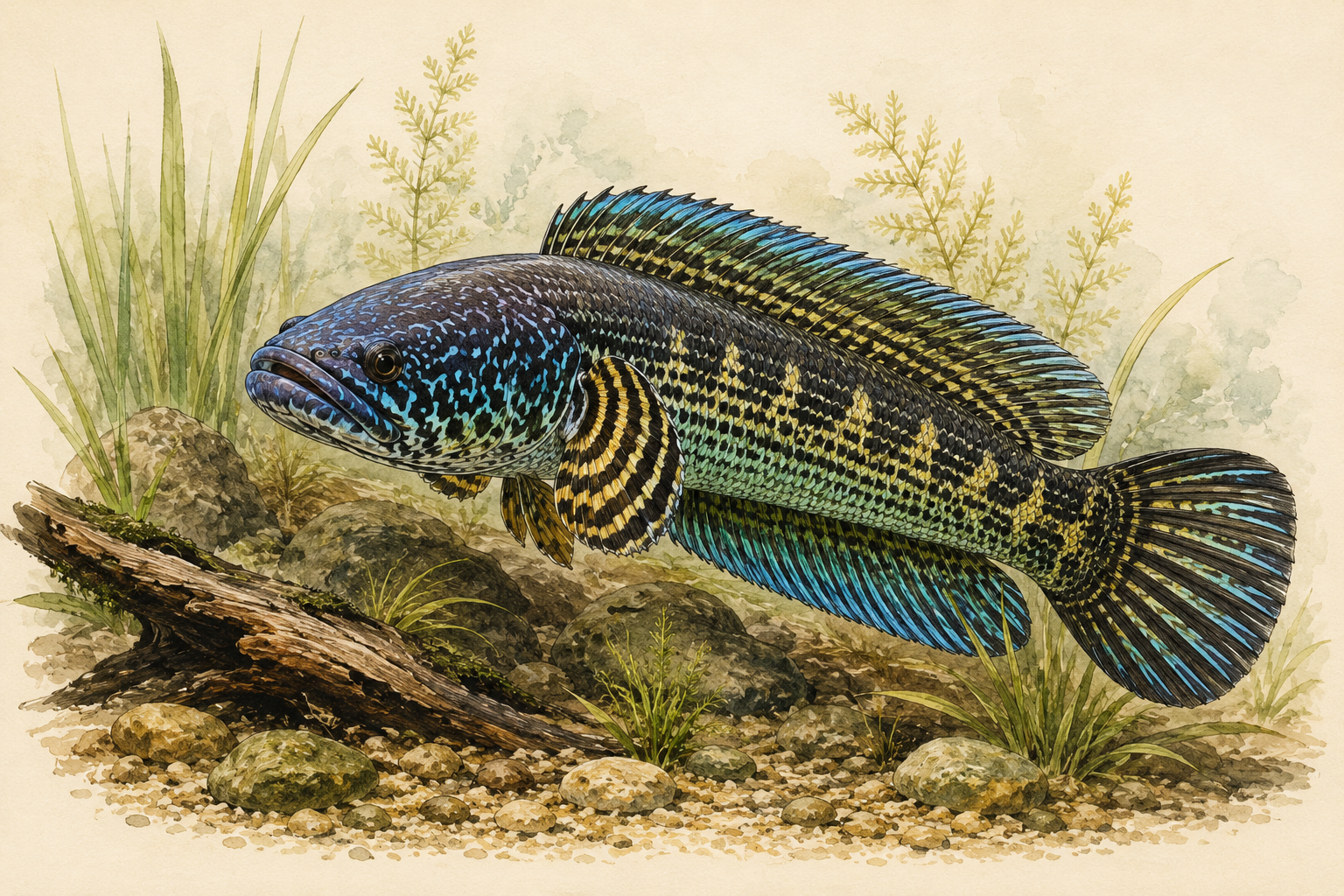
Channa aurantimaculata is a genuinely beautiful fish that commands attention in any aquarium. The body is elongated and cylindrical in the typical snakehead fashion, tapering to a rounded caudal fin. The head is broad, flattened, and distinctly serpentine, with a wide mouth lined with small but sharp teeth. The dorsal fin runs along most of the back, while the anal fin extends along a significant portion of the underside, giving the fish a powerful, undulating swimming motion.
The base body colour is a deep chocolate-brown to near-black, overlaid with a striking pattern of bright golden-orange to flame-orange blotches and irregular bands. These markings are most vivid along the flanks and extend onto the dorsal and caudal fins. The intensity of the orange colouration varies between individuals and can be influenced by mood, diet, and water conditions. When in peak condition, the contrast between the dark base and fiery orange markings is truly spectacular. Juveniles are generally duller, displaying more muted browns and greys, with the characteristic golden patterning intensifying as the fish matures over the first twelve to eighteen months.
Sexual dimorphism is subtle but present. Males tend to develop a broader, more blocky head shape and may grow slightly larger than females. Mature males often display more intense colouration, particularly during breeding condition. Females tend to be slightly more slender in the body and may show a marginally rounder belly when carrying eggs. However, reliably sexing young specimens is extremely difficult, and even experienced keepers sometimes struggle without observing courtship behaviour.
Natural Habitat
The Golden Cobra Snakehead is endemic to the Brahmaputra River drainage in the state of Assam in north-eastern India. Its known range is relatively restricted, with confirmed populations found in tributaries and associated wetlands within this basin. The region experiences a subtropical to tropical monsoon climate, meaning that water conditions fluctuate considerably throughout the year. During the cooler winter months from November through to February, water temperatures in these habitats can drop to as low as 12–15 °C, while during the hot pre-monsoon period from April to June, temperatures may rise to 28 °C or above.
In the wild, this species inhabits slow-moving streams, pools, and marshy areas with dense marginal vegetation. The substrate typically consists of mud, leaf litter, and decaying organic matter, which stains the water a dark tea-brown colour with tannins and humic acids. Submerged roots, overhanging vegetation, and fallen branches provide an abundance of cover. The water is generally soft and slightly acidic to neutral in pH. These environments are often shallow and may experience reduced oxygen levels, which is less of a concern for snakeheads given their ability to breathe atmospheric air directly.
This seasonal temperature variation is a crucial detail for aquarists, as it plays an important role in the fish’s long-term health and breeding cycle. Keeping Channa aurantimaculata at a constant high tropical temperature year-round can lead to stress, a shortened lifespan, and a failure to breed. Replicating the natural seasonal cycle, or at least providing a noticeable cool period during the winter months, is strongly recommended for serious keepers.
Tank Size and Setup
A single adult Golden Cobra Snakehead requires a minimum tank size of 450 litres, with dimensions that prioritise floor space over height. An aquarium measuring at least 150 cm in length and 60 cm in width should be considered the minimum for a single specimen. For a pair, which is the most common keeping arrangement for those interested in breeding, a tank of 600 litres or more with dimensions of at least 180 cm by 60 cm is advisable. Snakeheads are powerful fish that can produce sudden bursts of speed, and cramped conditions will lead to stress, aggression, and poor health.
The aquascape should be designed with the fish’s natural habitat in mind. A soft, sandy substrate or fine gravel works well and is kinder to the fish’s underside as it rests on the bottom. The tank should be generously furnished with hiding places using a combination of driftwood, bogwood, rock caves, and dense plantings. Robust aquatic plants such as Anubias, Java Fern, and Vallisneria can be used, though be aware that snakeheads may uproot less well-anchored vegetation during their more boisterous moments. Attaching plants to hardscape rather than planting directly into the substrate is a practical solution. Floating plants are an excellent addition, as they dim the lighting, provide a sense of security, and replicate the shaded conditions the fish experiences in the wild.
The addition of dried leaf litter, such as Indian almond leaves or oak leaves, is highly beneficial. Leaves release tannins into the water, lowering pH slightly, tinting the water a natural amber colour, and providing antifungal and antibacterial properties. They also encourage the growth of biofilm and microorganisms that contribute to a more natural environment. Replace leaves as they decompose.
A tight-fitting lid is absolutely essential. Snakeheads are notorious escape artists and will exploit even the smallest gap in a cover. They are strong enough to push aside loose-fitting lids, so the cover must be secure and weighted if necessary. At the same time, there must be a gap of humid air between the water surface and the lid, as the fish needs to breathe air from above the waterline. A space of at least five to eight centimetres is recommended. Ensuring this air pocket remains warm and humid is particularly important during cooler periods, as breathing cold, dry air can cause respiratory problems.
Water Parameters
| Temperature | 15–28 °C |
| pH | 5.5–7.5 |
| General hardness (GH) | 2–10 dGH |
| Carbonate hardness (KH) | 1–6 dKH |
| Ammonia | 0 ppm |
| Nitrite | 0 ppm |
| Nitrate | Below 20 ppm |
The most important consideration with water parameters for Channa aurantimaculata is the seasonal temperature cycle. For the majority of the year, a temperature of 22–26 °C is ideal. However, to maintain long-term health and especially to condition fish for breeding, a cool period during the winter months is highly beneficial. Gradually reducing the temperature to 15–18 °C over a period of several weeks, maintaining it at this cooler range for two to three months, and then slowly raising it again in spring closely mirrors the fish’s natural cycle. This can be achieved simply by turning off the aquarium heater in a room that experiences normal seasonal temperature changes, or by using a heater with a thermostat set to the desired lower temperature.
Soft, slightly acidic to neutral water is preferred, though the species is reasonably adaptable within the ranges listed above. Consistency and cleanliness are more important than hitting an exact number. Ammonia and nitrite must be maintained at zero at all times, and nitrate should be kept as low as possible through regular water changes. A weekly water change of 25–30 per cent is a good starting point, though larger or more frequent changes may be necessary depending on stocking and filtration capacity. Always dechlorinate replacement water and try to match it to the tank’s temperature to avoid sudden shocks.
Filtration and Equipment
Given the size of the tank required and the fact that snakeheads are messy, protein-rich feeders, robust filtration is non-negotiable. A large external canister filter rated for the tank’s volume, or ideally for a tank somewhat larger, is the most practical choice. Many keepers opt to run two canister filters simultaneously to provide redundancy and ensure adequate biological and mechanical filtration. The combined turnover rate should aim for at least four to six times the tank volume per hour.
Filter media should include a generous amount of biological media such as sintered glass or ceramic rings, supplemented with mechanical filtration pads and, optionally, chemical media such as activated carbon or peat granules. Peat can be particularly useful for naturally softening water and releasing beneficial tannins. Sponge pre-filters on canister intakes help protect the impeller from debris and extend maintenance intervals.
Water flow should be moderate. Channa aurantimaculata comes from slow-moving or still waters and does not appreciate a strong current. Position filter outlets to avoid creating a powerful flow across the tank, or use spray bars to diffuse the output. Aeration is less critical than for most fish given the species’ air-breathing ability, but gentle surface agitation still helps with gas exchange and overall water quality. A heater with an accurate thermostat is required for most of the year, ideally a model with an external controller or a heavy-duty inline heater for larger setups. Protect any in-tank heater with a guard, as snakeheads can damage equipment with their powerful movements.
Lighting should be subdued. This species is most active and displays its best colouration under dim conditions. Floating plants help to achieve this naturally. A standard LED light on a timer providing around eight to ten hours of illumination per day is sufficient, but avoid overly bright setups unless the lighting is heavily diffused by plant cover.
Diet and Feeding
The Golden Cobra Snakehead is a carnivorous predator with a strong feeding response. In the wild, its diet consists primarily of small fish, amphibians, insects, and crustaceans. In captivity, a varied diet based on high-quality protein sources is essential for maintaining health, colour, and vigour.
The staple diet can be built around good-quality carnivore pellets or sticks, which many specimens can be trained to accept with patience. Hikari Massivore, Northfin Predator, and similar sinking pellet foods are commonly used. Supplement this with a variety of fresh and frozen foods including prawns, mussels, earthworms, river shrimp, lance fish, and whitebait. Live foods such as earthworms, crickets, and appropriately sized feeder shrimp make excellent enrichment and help to stimulate natural hunting behaviours. Avoid feeding live feeder fish from pet shops, as these carry a high risk of introducing parasites and disease.
Juvenile fish should be fed daily, gradually transitioning to feeding every other day or three to four times per week as they reach adulthood. Overfeeding is a common problem with snakeheads, as they are enthusiastic eaters and will readily gorge themselves. A slightly hungry snakehead is a healthier snakehead. Monitor body condition carefully and adjust feeding frequency accordingly. Obese fish are more prone to fatty liver disease and other health problems. The occasional fast of a few days is perfectly natural and can be beneficial.
Variety is key to a balanced diet. No single food item should make up the entirety of the diet. Rotating between pellets, frozen foods, and occasional live offerings ensures the fish receives a full spectrum of nutrients and prevents dietary deficiencies.
Behaviour and Temperament
Channa aurantimaculata is often described as one of the more personable snakehead species, and many keepers report that their fish quickly learn to recognise them and will approach the front glass in anticipation of food. This intelligence and interactivity is one of the species’ greatest appeals. They are curious, observant fish that will watch activity in the room with apparent interest.
However, it is important not to underestimate the predatory and territorial nature of this species. The Golden Cobra Snakehead is a capable ambush predator that will consume any fish small enough to fit in its mouth, and its mouth is considerably larger than it might first appear. Aggression towards conspecifics and other fish can be significant, particularly in undersized tanks or when territories are not clearly defined by hardscape.
Pairs can be kept together, and indeed this is the preferred arrangement for breeding, but pair formation is not straightforward. Introducing two random individuals into the same tank can result in serious aggression and even death. The safest approach is to raise a small group of juveniles together and allow a pair to form naturally, removing the remaining fish once a bond is established. Even bonded pairs may experience bouts of aggression, particularly outside of breeding season, so ample space and line-of-sight breaks in the form of dense hardscape and planting are essential.
This species is primarily crepuscular, being most active during dawn and dusk. During the middle of the day, the fish often rests in a favourite hiding spot, sometimes lying motionless among plants or wedged between pieces of driftwood. This resting behaviour is entirely normal and should not be mistaken for illness. Activity levels tend to increase noticeably during feeding times and in the hours before and after the lights go out.
Tank Mates
Choosing tank mates for the Golden Cobra Snakehead requires careful consideration of size, temperament, and the dimensions of the aquarium. As a predatory species with a territorial nature, it is best kept either as a single specimen, as a bonded pair, or with a small number of carefully selected companions. Any potential tank mate must be too large to be swallowed, robust enough to hold its own without being aggressive enough to harass the snakehead, and tolerant of the same water conditions, including the seasonal cool period.
Good tank mates
- Common Pleco (Hypostomus plecostomus), a large, armoured catfish that occupies a different niche, spends much of its time on surfaces, and is generally ignored by snakeheads.
- Bristlenose Pleco (Ancistrus sp.), a hardy, bottom-dwelling catfish that stays out of the snakehead’s way and helps with algae control, though choose only larger specimens.
- Giant Gourami (Osphronemus goramy), a large, robust labyrinth fish with a calm temperament that can coexist with snakeheads in sufficiently spacious tanks.
- Clown Loach (Chromobotia macracanthus), a sociable, deep-bodied loach that, when kept in a group and at adult size, is generally too large and too active to be targeted.
- Sailfin Pleco (Pterygoplichthys gibbiceps), another well-armoured pleco species that reaches a good size and is typically left alone by territorial predators.
- Featherfin Synodontis (Synodontis eupterus), a peaceful, mid-sized catfish that tends to be nocturnal and stays near the bottom, reducing territorial conflict.
- Silver Dollar (Metynnis hypsauchen), a deep-bodied, fast-swimming schooling fish that is generally too large and too quick to be considered prey by a medium-sized snakehead.
- Senegal Bichir (Polypterus senegalus), a hardy, armoured bottom-dweller that occupies different territory and is well-protected by its ganoid scales.
Fish to avoid
- Neon Tetra (Paracheirodon innesi), far too small and will be immediately consumed as live food by any snakehead.
- Guppy (Poecilia reticulata), Tiny, slow-moving fish that would be an easy and inevitable meal.
- Oscar (Astronotus ocellatus), a large, territorial cichlid that requires warm tropical temperatures year-round and is likely to engage in damaging territorial disputes.
- Flowerhorn Cichlid, an extremely aggressive hybrid cichlid that would almost certainly fight with a snakehead, risking serious injury to both fish.
- Dwarf Gourami (Trichogaster lalius), Much too small and too timid to survive alongside a predatory snakehead.
- Cherry Shrimp (Neocaridina davidi), Invertebrates of this size are natural prey items and would be consumed within minutes.
- Angelfish (Pterophyllum scalare), too slow, too small, and too delicate to coexist safely with a large predatory species.
- Betta (Betta splendens), far too small and far too slow, with flowing finnage that would make it an easy target.
Breeding
Breeding Channa aurantimaculata in captivity is a challenging but achievable goal and one of the most rewarding experiences available to the dedicated snakehead keeper. This species is a mouthbrooder, with the male typically taking on the role of incubating the eggs in his buccal cavity, though both parents participate in fry care. Successful breeding almost always requires a bonded pair that has formed naturally, a seasonal temperature cycle, and a mature, well-maintained aquarium.
Conditioning for breeding begins with the winter cool period described earlier. Reducing the temperature to 15–18 °C for two to three months, then gradually raising it back to 24–26 °C over several weeks, simulates the transition from winter to the monsoon season and triggers spawning behaviour. During the warming phase, increase feeding frequency and offer a variety of high-quality live and frozen foods to bring the pair into peak condition.
Courtship can be intense and sometimes alarming. The pair may engage in vigorous jaw-locking, chasing, and displays that can look aggressive. This is normal behaviour, but keepers should monitor closely and be prepared to separate the pair if injuries become severe. Providing plenty of cover and space allows the female to retreat if needed. Spawning typically occurs in a sheltered area of the tank, often among dense vegetation or within a cave-like structure.
After spawning, the male collects the eggs in his mouth and incubates them for approximately two to three weeks, during which time he will refuse all food. It is essential not to disturb the male during this period, as stress can cause him to swallow or spit out the eggs prematurely. The female may assist in guarding the territory around the brooding male. Once the fry are released, they are relatively large and can be fed on baby brine shrimp, microworms, and finely chopped bloodworm. Both parents typically display active brood care, guarding the fry for several weeks after release. Fry should eventually be separated from the adults as they grow, since parental tolerance diminishes over time and smaller fry may be consumed.
Common Diseases
Channa aurantimaculata is generally a hardy species when kept in appropriate conditions, but it is not immune to disease. The most frequently encountered health issues in captive snakeheads relate to poor water quality, overfeeding, and unsuitable temperatures.
Bacterial infections are perhaps the most common ailment, often manifesting as skin ulcers, fin rot, or cloudy eyes. These are almost always secondary to environmental stress, particularly elevated ammonia or nitrite levels, or injuries sustained during aggressive encounters. Treatment involves correcting the underlying water quality issue and, in severe cases, using a broad-spectrum antibacterial medication. Maintaining clean water through regular changes and adequate filtration is the single best preventative measure.
Fungal infections can also occur, particularly on damaged skin or around wounds. These appear as white or grey cotton-like growths. Tannin-rich water from leaf litter and driftwood provides a degree of natural antifungal protection, and mild cases often resolve on their own in clean, well-maintained water. More persistent infections may require treatment with a proprietary antifungal remedy.
Internal parasites are a risk with wild-caught specimens and fish that have been fed live feeder fish. Symptoms include weight loss despite a good appetite, white stringy faeces, and lethargy. Treatment with an anti-parasitic medication such as those containing praziquantel or levamisole is usually effective. Quarantining new arrivals for at least four weeks before introducing them to an established tank is strongly recommended.
Respiratory issues can arise if the air above the water surface is cold or dry while the water itself is warm. The suprabranchial organ is sensitive, and breathing cold air can lead to inflammation or infection. Ensuring that the tank has a tight-fitting lid that maintains a warm, humid air pocket above the waterline prevents this problem. This is particularly important during cooler months if the tank is in an unheated room.
Obesity and fatty liver disease are long-term consequences of overfeeding, which is unfortunately very common with snakeheads due to their enthusiastic feeding response. Feeding appropriate portions on an every-other-day schedule for adults, combined with regular fasting days, helps to prevent these conditions.
FAQs
Can I keep a Golden Cobra Snakehead in a tropical community tank?
No, this is not a suitable species for a standard tropical community. The Golden Cobra Snakehead is a predator that will eat any fish small enough to fit in its mouth, and it requires a seasonal cool period that is incompatible with most tropical species. It is best kept as a single specimen or a bonded pair, potentially with a small number of carefully chosen large, robust tank mates in a spacious aquarium specifically designed around its needs.
Is it legal to keep snakeheads in the UK?
Yes, it is legal to keep snakeheads in private aquaria in the United Kingdom, and several species including Channa aurantimaculata are available through specialist dealers. However, it is important to note that the release of any snakehead into wild waterways is illegal and ecologically irresponsible. In some other countries, including several US states, the keeping of snakeheads is restricted or banned outright, so always check your local legislation before acquiring one.
Do Golden Cobra Snakeheads really need a cool period?
While it is technically possible to keep this species at a stable subtropical temperature year-round, providing a cool period of 15–18 °C during the winter months is highly beneficial. It supports the fish’s natural metabolic cycle, reduces long-term stress, and is essentially a prerequisite for triggering breeding behaviour. Fish that are denied this seasonal variation often show reduced colouration, shorter lifespans, and a general lack of vitality compared to those kept with a more natural temperature regime.
How do I get a Golden Cobra Snakehead to accept pellet food?
Many snakeheads can be weaned onto pellet food with patience. Start by offering pellets alongside favoured frozen or live foods. Over time, gradually reduce the proportion of fresh food and increase the pellets. Some keepers find that soaking pellets in prawn juice or fish oil makes them more appealing initially. Not all individuals will accept pellets, and in such cases a diet of varied frozen and fresh foods is perfectly adequate provided it is sufficiently diverse.
How aggressive are Golden Cobra Snakeheads towards each other?
Conspecific aggression can be significant, and randomly pairing two adults in the same tank often leads to serious fighting and potential fatalities. The safest approach is to raise a group of juveniles together and allow a pair to bond naturally. Even bonded pairs can have aggressive episodes, particularly outside of breeding season or in cramped conditions. A large tank with abundant cover and line-of-sight breaks is essential for keeping more than one individual. Always have a plan to separate fish if aggression escalates beyond normal sparring.
Related Guides
- Rainbow Snakehead (Channa bleheri) Care Guide, a smaller, more colourful snakehead species from the same region of India, ideal for keepers interested in the genus but with less space available.
- Channa pulchra Care Guide, another attractively marked dwarf snakehead species that shares similar care requirements, including the need for a seasonal cool period.
- Channa stewartii Care Guide, a closely related species from Assam that is sometimes confused with Channa aurantimaculata and requires comparable husbandry.
- Predatory Fish Tank Setup Guide, a comprehensive guide to designing and equipping aquaria for large predatory freshwater species, covering filtration, security, and aquascaping strategies.
- Indian Almond Leaves and Botanical Aquaria Guide, a detailed look at using leaf litter, tannins, and botanicals to create blackwater conditions that benefit species like snakeheads.